
Buying & shipping · First import
How to Order Granite Monuments from India: Drawing to Container
The hard part of a first import is not the stone. It is not knowing what happens between sending a drawing and a truck arriving at your yard. Here is the whole sequence, in order, with the places first-time buyers actually get caught.
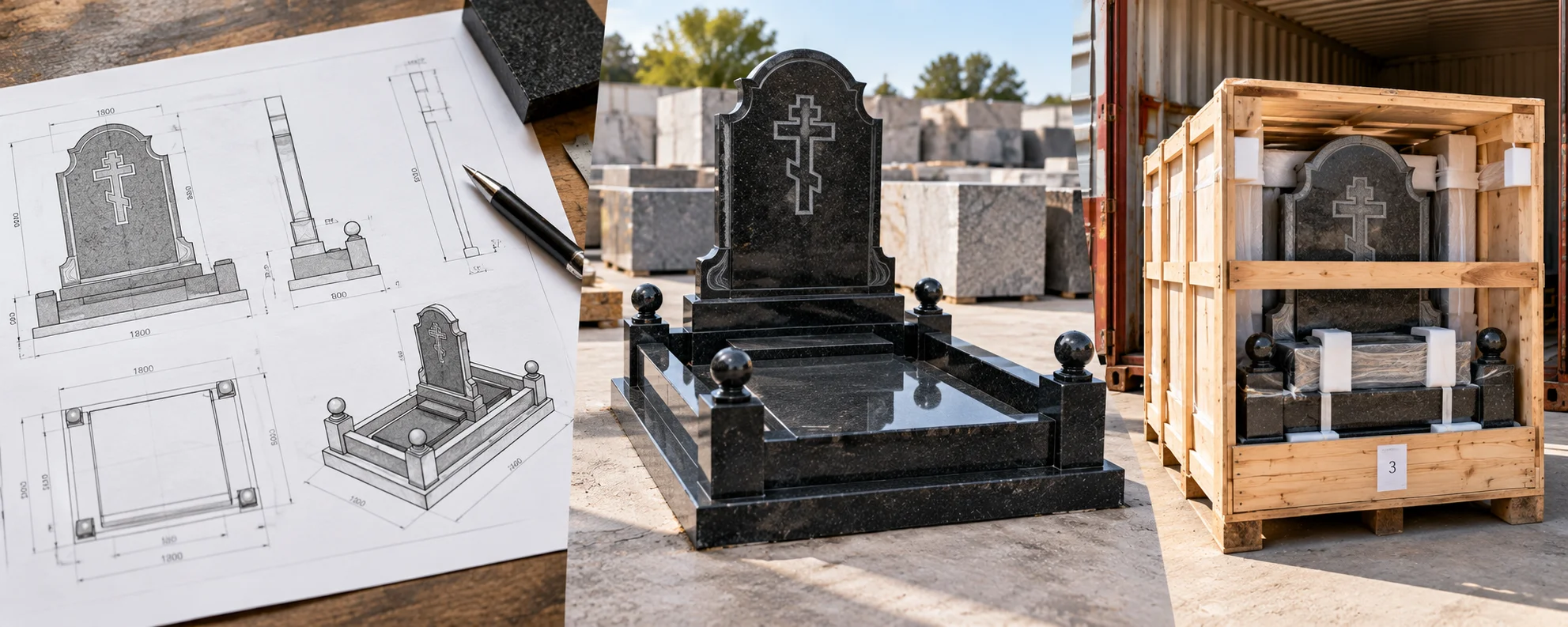
Before anything: what you actually need to send
You do not need a finished technical drawing to get a price. In fifteen years of enquiries, the ones that move fastest arrive with three things, and nothing more:
- The shape and the sizes. A sketch on paper with two real dimensions is enough. A photograph of a monument you already sell, with the sizes written on it, is enough. A CAD file is ideal but not required.
- The stone. The name your customer expects — габбро-диабаз, Absolute Black, Steel Grey — or simply “dark grey, polished”.
- The quantity. Not a polite number. The real one, including what you expect to reorder, because container counts move the rate more than anything else on the sheet.
Everything else — the polish specification, the lettering, the packing — we will ask you for as it becomes relevant. Nobody gets held up waiting for a drawing to be perfect.
The eight steps, in order
1. Enquiry
You send the shape, the sizes, the stone and the quantity. If any of the four is missing we will ask once, not three times. For memorial work, add the cemetery rule sheet if one applies — in many markets it decides the product before the family ever sees a design.
2. Quotation
You get unit rates, the container quantity those rates assume, the incoterm (FOB an Indian port, or CIF yours), and the lead time. Read the quantity line carefully: a per-piece rate for twenty pieces and a per-piece rate for a full container are different numbers, and a quotation that does not say which it is has told you very little.
A rate that moves after the proforma is not a rate. Ask directly whether the price is held for the order once the proforma invoice is issued. It should be. If it is not, you want to know that now rather than three weeks into production.
3. Production drawing
This is the step that protects both sides, and the one first-time buyers often try to skip. We draw your enquiry up properly — every dimension, the polish specification face by face, the lettering layout — and send it back for signature. Nothing is cut until that sheet comes back signed.
It feels like a delay. It is the opposite. Stone is subtractive: there is no putting it back. A sheet that takes two days to agree saves the six weeks a replacement would take.
4. Sample approval
For a first order, always take samples. We courier the stone in the finish you have specified so you judge the shade and grain in your own light. Black granite in particular is impossible to judge from a screen — two stones that look identical in a product photograph can sit two shades apart on a plot.
5. Block reservation and production
Once the sheet is signed, blocks are reserved for the whole job before cutting starts. That is what keeps a monument, its kerbs and its vases on one shade. Then the piece runs through the works: cutting, shaping, polishing to the specification you signed, carving if there is any, and lettering.
6. Lettering proof
If we are cutting the inscription, the layout comes back to you at full size with every character as it will be blasted. A misspelt name is not a repair; it is a replacement. Send the text as a document, one line per row — we do not retype from photographs, because that is exactly where errors enter.
7. Inspection and crating
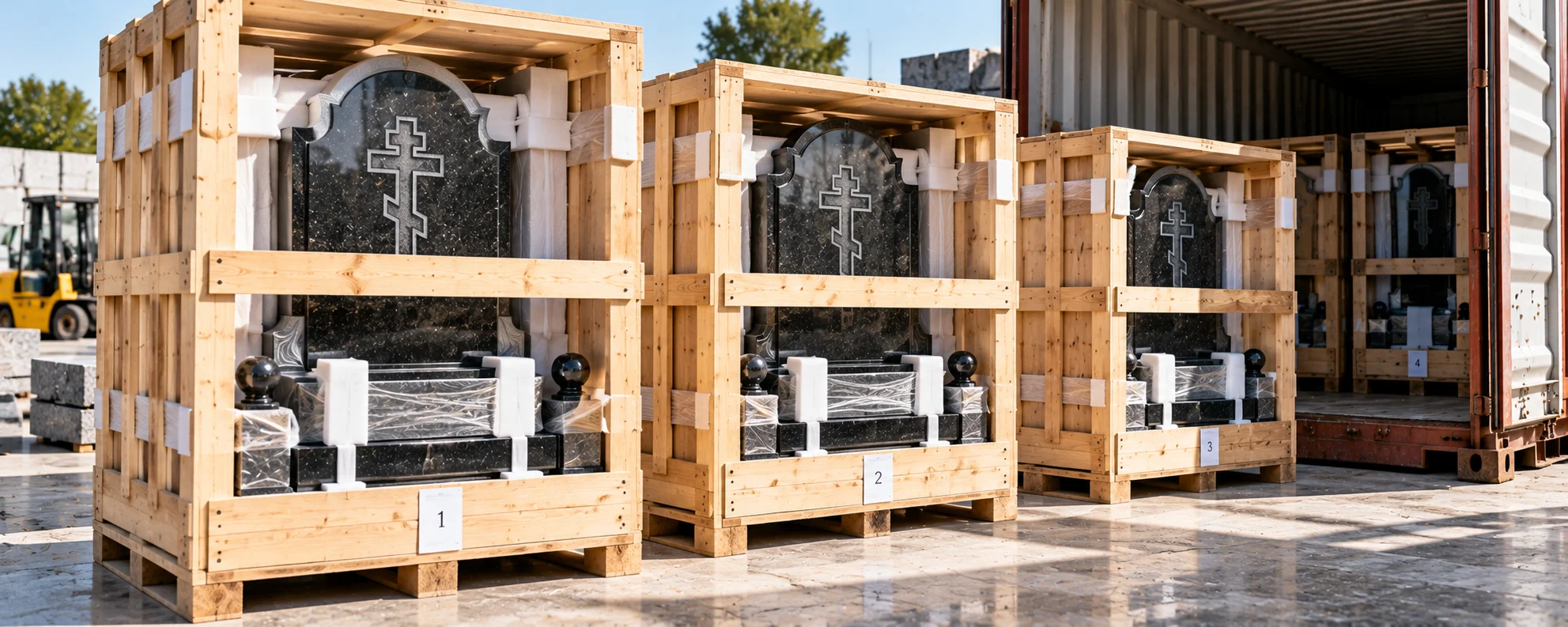
Each finished piece is measured against the signed drawing and photographed. Crates are built around the pieces, faces boarded, arrises taped, each crate weighed individually and numbered to the packing list. For structures the crates are numbered in setting order, so the first crate your crew opens holds the plinth, not the dome.
8. Shipping and documents
The container is stuffed, sealed and photographed. You get the invoice, the packing list with weights and marks, the bill of lading and the certificate of origin. Then the sea leg, then customs at your end, then the road leg — which, on most routes, is where the handling actually gets rough.
How long it takes, honestly
Lead time depends far more on what you ordered than on where it came from. As a rough shape of the thing:
| Stage | What drives it |
|---|---|
| Quotation | A day or two for standard work; longer if the piece is carved or structural |
| Drawing and signature | Mostly your side — it moves as fast as you return it |
| Samples | Courier time to your country |
| Production | Blank stock is fastest; lettering adds steps; carving adds the most |
| Sea freight | Route and schedule, not the supplier |
Ask for the lead time in writing on the quotation, and ask what it is measured from — the order date, or the date the signed drawing comes back. Those are not the same day.
What a sensible first container looks like
Here is the advice we give most first-time buyers, and it costs us a little in the short term. Do not make your first container a single line.
Take a typical example: a workshop that sells uprights, kerb sets and vases. Rather than ordering forty of one monument shape on a hunch, order a spread — two or three shapes, a few kerb sets, vases and a small quantity of blank stock for lettering locally. One shipment, marked and listed separately, and by the end of the season you know what actually sells in your market instead of guessing. The second order is then placed on evidence.
Granite also reaches the weight limit long before it fills the space, so a stone container is nearly always weight-limited rather than volume-limited. Tell us the weight limit at your port and the loading plan is built to it — and if a line comes up short, it is easy to top the load up.
Five things that catch first-time importers
- Agreeing a price before the format is clear. A square-metre rate for slabs and a piece rate for finished units are not comparable numbers. Settle the format first.
- Skipping the sample. Nothing causes more friction than a shade argument after a container has landed, and nothing is easier to avoid.
- Splitting a plot across two shipments. Monument now, kerbs in March, from different runs — the family will see it, even if they cannot name what is wrong.
- Not stating the units. Inches or millimetres. One line on the drawing prevents most size errors that ever happen.
- No plan for the road leg. Crate weights matter because your yard needs a forklift that can lift them. Ask for weights per crate on the packing list.
If something does arrive wrong
It happens, rarely, and the way you handle the first hour decides everything. Photograph the damage before the goods are worked or installed, with the crate number visible in the frame. That is what a carrier or an insurer will ask for, and it is what lets a supplier replace the piece quickly rather than argue about where it happened.
Keep the packing list. Every crate on it is weighed and numbered for exactly this reason.
Frequently asked questions
Do I need a technical drawing to get a price?
No. A sketch with two real dimensions, or a photograph with sizes written on it, is enough to quote standard work. We draw it up properly and send the production sheet back for your signature before anything is cut.
What is the minimum order?
In practice, the unit that makes sense is a container, because freight on a part load rarely works out for stone. A first container does not have to be one product — several lines can travel together, marked and listed separately.
FOB or CIF — which should I ask for?
FOB if you have a freight forwarder you trust and want to control the shipping. CIF if you would rather have one number to your own port. Ask for both on the quotation; the comparison tells you a lot.
Can you letter in Cyrillic, Armenian or other scripts?
Yes, in your workshop’s own fonts, with full-size proofs before blasting. Send text as a document rather than an image. Alternatively take blank stock and letter it yourself — many dealers prefer that, because it keeps the lettering margin in their own shop.
Will the second order match the first?
If the drawings, block numbers and lettering layouts are kept on file, yes — a repeat is a re-order rather than a redesign. Ask your supplier directly whether they keep that record. Many do not.
Can I visit the works before ordering?
Buyers are welcome at any stage. We are in Krishnagiri district, Tamil Nadu, around two hours from Bengaluru airport. If you cannot travel, send a third-party inspector, or ask for measured photographs of each piece before crating.
In short
Importing granite monuments is not complicated, but it is sequential. Shape, sizes, stone and quantity get you a real quotation. A signed drawing protects both sides. A sample settles the shade. A reserved block run keeps a plot matching for the next decade. Everything after that is logistics, and logistics is the easy part.
If you are weighing up a first import, the useful first step is not a price list. It is a drawing — even a rough one — and an honest conversation about what you actually sell.
Send the sketch and the sizes. We will send back a production drawing, a written quotation with the container quantity on it, and samples of the stone you asked for.
Request a quotation


