Russia & CIS · Stone selection
Gabbro-Diabase Equivalents: Which Indian Granite Matches Karelian Black?
Nearly every monument drawing that reaches our works from Russia names the same stone: габбро-диабаз. Here is what that stone actually is, which Indian blacks sit closest to it, and the four things to check before you let a substitute into a job.
First, what gabbro-diabase actually is
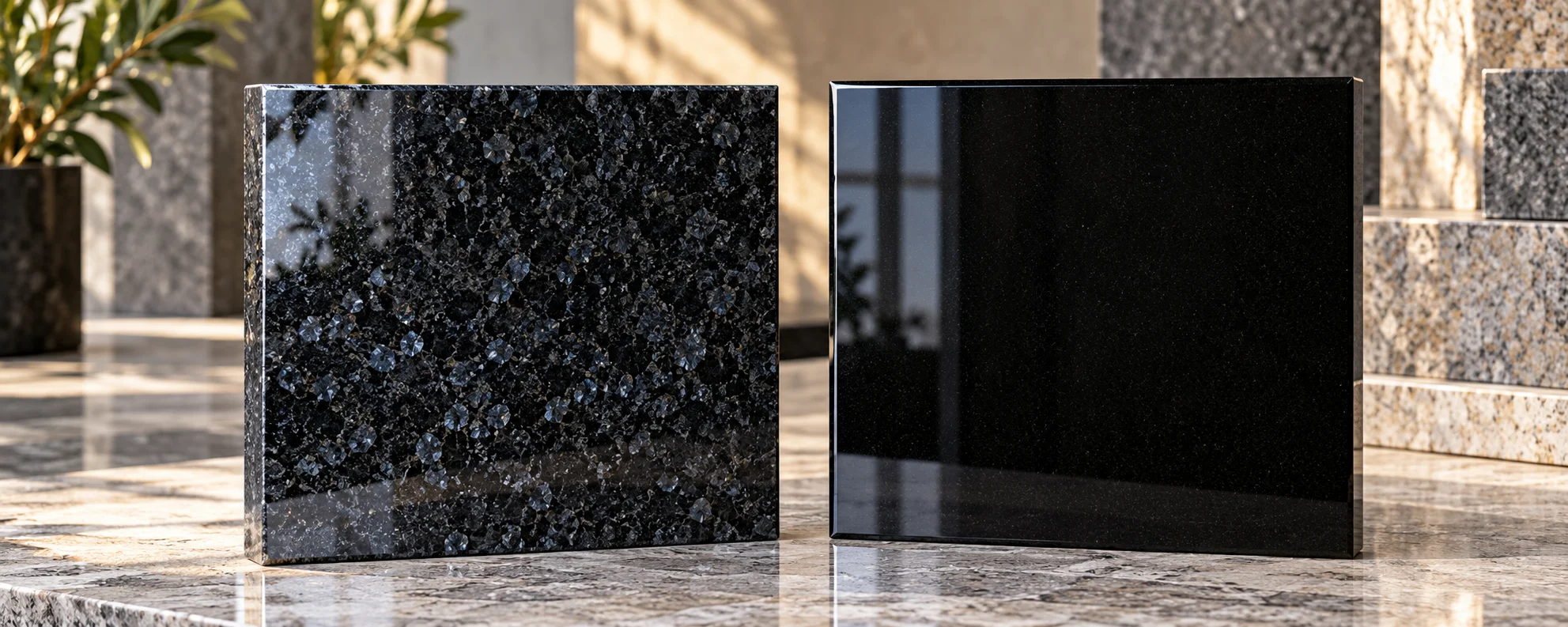
Gabbro-diabase is not a brand and it is not a quarry name. It is a rock type — a dark, intrusive igneous rock that cooled slowly enough underground to form interlocking crystals, but fast enough that those crystals stayed fine. In Russia the best-known source is Karelia, which is why the trade says “Karelian black” and “габбро-диабаз” as if they were the same thing.
What makes it the default memorial stone across Russia and the CIS is not romance. It is three practical properties: it is very dark without polishing tricks, the grain is fine and even, so a sandblasted letter edge stays sharp, and it is dense with low water absorption, so it survives freeze-thaw winters and thirty years of spring washing without the face going chalky.
Why workshops come looking for an equivalent
In our experience the enquiry almost never starts with “we want something cheaper”. It usually starts with one of these:
- Block size. A large family memorial, a chapel element or a two-metre cross needs a block that is not always available in the size and shade you want, when you want it.
- Lead time. A workshop with orders booked for the season cannot wait on a single source.
- Consistency across a repeat order. The second stone, cut a year later, has to match the first — and a plot where the monument and the kerbs came from different runs is obvious to the family, even if nobody can explain why.
- Finished units rather than raw material. Some buyers would rather receive the monument cut, polished and lettered than buy a block and process it themselves.
The honest answer: you are not looking for a copy, you are looking for the same rock family
Here is the part most supplier websites will not tell you plainly. There is no Indian stone that is identical to a Karelian block — two quarries never give identical stone, and two blocks from the same quarry are not identical either. What there is, and it matters more, is the same family of rock with the same working behaviour.
India’s best-known memorial black, sold in the trade as Absolute Black, is geologically a dolerite — and dolerite and diabase are two names for the same rock. That is not marketing. It is why the stone behaves the way a Russian carver expects it to: it takes a mirror polish without filler, it holds a blasted letter edge, and it does not fade to grey after a few winters the way some softer blacks do.
The three Indian blacks worth sampling
| Stone | Character | Where it fits | Watch for |
|---|---|---|---|
| Absolute Black | Uniform jet black, very fine even grain, no visible figure | The closest working match. Monuments, крест, plaques, portrait etching | Quality varies by quarry run — insist on one block run for a whole job |
| Premium Black | Dense black, fine grain, occasionally a slightly warmer cast | Volume work, kerbs, covers, blank stock for your own lettering | Compare under the same light as your reference before committing |
| Bengal Black | Deep black, very even batch to batch | Repeat orders and phased jobs where consistency beats drama | Slightly less deep than Absolute Black on a mirror polish |
The one that is not a match: Black Galaxy. It is a beautiful stone and it sells well, but the golden speckle competes with fine lettering and it reads nothing like a Karelian block. If a customer has been shown gabbro and then offered Galaxy, they will notice — and they will blame the workshop, not the supplier.
Four checks before you let a substitute into a job
1. Compare polished samples, not photographs
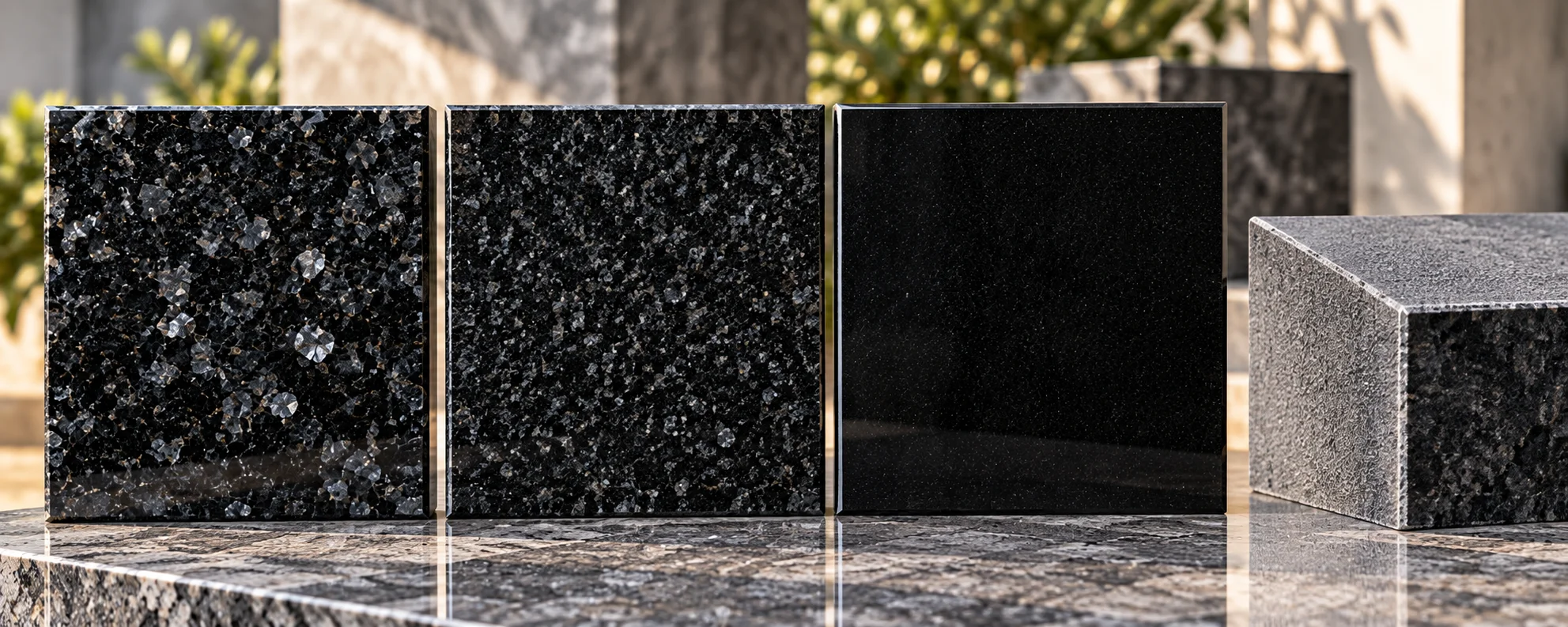
Black granite is the hardest material in the world to judge on a screen. Two stones that look identical in a product photo can sit two shades apart on a plot. Hold your reference piece and the sample side by side, in daylight, with the same finish on both. Thirty seconds settles what a week of emails cannot.
2. Look at the grain, not just the colour
Shade is what the family notices on day one. Grain is what decides whether the lettering still reads in twenty years. A coarser crystal means a slightly ragged blasted edge, and on a portrait it means lost detail in the fine tones. Tilt the sample to the light rather than looking at it flat.
3. Ask for the test report on your consignment, not on the stone type
A certificate that says “Absolute Black, water absorption low” proves very little. Granite is quarried, not manufactured, and properties vary between runs. What is worth having is an independent laboratory report for the material actually being shipped to you — water absorption first, then density and flexural strength. Any supplier who will not provide that per consignment is telling you something.
4. Settle the block run before the price
This is the question we wish more buyers asked us first. If a monument, its kerbs, the cover and the vases are cut from one reserved block run, they will still match in ten years. Released piecemeal over two shipments, they will be close — and close is what the family sees.
What this looks like on a real order
Take a typical enquiry: a workshop needs twenty double monuments with portraits, kerb sets for all twenty, and matching vases, delivered across two shipments because the cemetery season has not started yet.
The wrong way to run that order is to buy the monuments now and the kerbs in March. The right way is to agree the stone, reserve the block run for the whole requirement up front, cut everything from it, and then ship it in two parts. The buyer gets their cash flow; the plots still match. Nothing about that is clever — it is simply knowing which decision has to happen first.
Lettering, portraits and the thing nobody checks
Russian and Armenian work leans heavily on etched portraits, and portraits are where the choice of black earns or loses its money. A fine, even grain holds the mid-tones of a face; a coarse or speckled stone eats them. If portraits are a significant part of your work, judge any candidate stone on a test etch, not on a polished tile.
The same applies to gilded lettering. Gold leaf on a mirror-polished dark stone is the most legible combination in memorial work — but only if the polish is genuinely flat. Ask to see a sample with a few blasted characters and a gilded line on it, and you will learn more than any brochure can tell you.
Frequently asked questions
Is Indian Absolute Black the same stone as gabbro-diabase?
Not the same quarry, but the same rock family. Indian Absolute Black is a dolerite, and dolerite and diabase are two names for the same rock type. That is why it behaves similarly under the saw, the polisher and the blast nozzle.
Will my customers notice the difference?
On a single monument, rarely — provided the shade was matched against a real sample. On a plot where the monument and the fittings came from different sources, almost always. The risk is not the stone, it is mixing runs.
Can I buy blocks and slabs instead of finished monuments?
Yes. Workshops with their own saws usually take blocks or gangsaw slabs; dealers without a plant take finished, lettered units. Both can travel in the same container.
How do I check the stone survives a northern winter?
Water absorption is the number that matters most for freeze-thaw. Ask for an independent laboratory report on the consignment you are buying, not a generic certificate for the stone type.
Can you letter in Cyrillic and Armenian?
Yes — in your workshop’s own fonts, sandblasted or engraved, painted or gilded, with full-size proofs returned before anything is cut. Send the text as a document, never as a photograph; that is where errors start.
How do I get samples?
Tell us the stone name your customer expects and the finish you are considering. We courier the closest Indian matches so you judge the shade and the grain yourself, rather than taking our word for it.
In short
If a drawing says габбро-диабаз, you are not hunting for a clone. You are looking for a dense, fine-grained black of the same rock family, supplied in a way that keeps a whole job on one run. Absolute Black is where almost every one of those conversations ends up — but only after the samples have been held side by side, and only after someone has decided whether the monument and its kerbs are coming off the same block.
Send the stone name your customer expects. We will courier the closest Indian match beside it — in your finish — so the shade is settled by you, not by a photograph.
Request samples and a quotation


