
Memorial products · Plot sets
Whole-Plot Memorial Sets: Why the Vase Must Come from the Same Block
A grave plot is six pieces of stone seen in one glance, for thirty years. Buy them from different runs and the family will know something is wrong long before anyone can explain what. Here is why that happens, and how workshops avoid it.
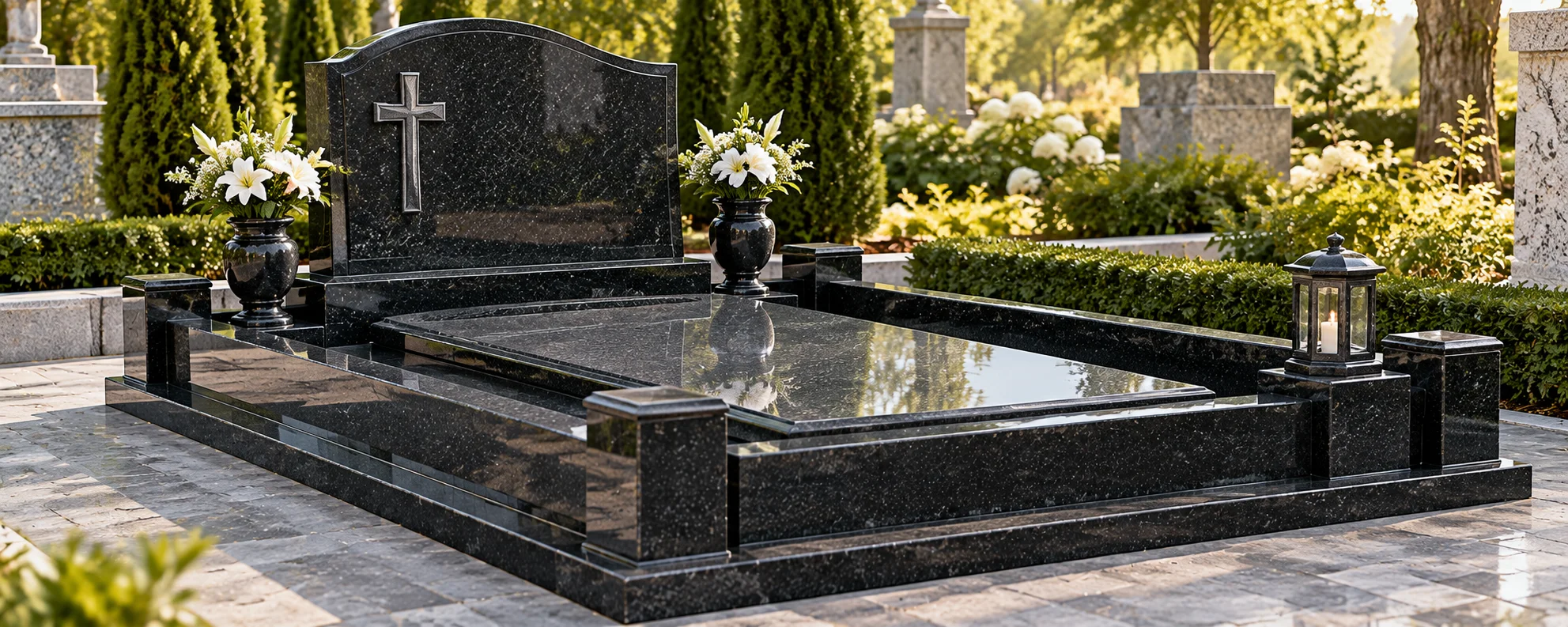
Granite is quarried, not manufactured
This is the sentence the rest of the article hangs on, and it is the one most buyers have heard but not fully absorbed.
Two blocks from the same quarry, cut the same month, from faces fifty metres apart, are not the same stone. They are the same name. The shade shifts, the grain tightens or opens, the speckle density changes. None of this is a defect — it is what natural stone is. A ceramic tile is manufactured to a batch standard; a granite block is a piece of the earth with its own history.
On a single headstone standing alone, that variation is invisible. Nobody compares it to anything. On a plot where a monument, kerbs, a cover and two vases sit within a metre of each other, it is the first thing the eye picks up — even when the person looking cannot say why the plot feels slightly wrong.
What a “whole plot” actually contains
Before the shade argument, it helps to be clear about how many separate pieces of stone are involved. In Russian and CIS work, a complete plot usually means:
| Piece | What it does | Why it matters to the match |
|---|---|---|
| Monument (стела) | Carries the portrait and the inscription | The reference piece — everything else is judged against it |
| Kerbs | Frame the plot: head, sides, foot | Longest run of stone on the plot, so any drift shows most here |
| Cover slab | Closes the plot, or a tray for planting | Largest single surface after the monument |
| Vases (вазы) | Flowers, usually a pair | Small, handled, seen close up — polish quality shows |
| Flowerpot / цветник | Planting at the foot | Sits directly against the kerb, so a mismatch is side by side |
| Lantern or plaque | Candle housing, name plate, second inscription | Often ordered later — the classic mismatch |
Six pieces, six chances to break the set. And in most workshops, at least two of them are bought from a different supplier than the monument.
How the mismatch usually happens
Nobody sets out to deliver a plot that does not match. It happens through perfectly reasonable decisions, one at a time:
- The monument is ordered first, because that is what the family chose and paid a deposit on.
- The kerbs are ordered later, from whoever is quickest or cheapest that month — they are “just kerbs”.
- The vases come from stock, because every workshop has a few on the shelf.
- The lantern or second plaque is added a year on, when the family asks for it after the second burial.
Four sensible decisions, four different block runs, one plot that never quite settles. And the complaint, when it comes, does not arrive as “your stone varies”. It arrives as “this doesn’t look right” — which is much harder to answer.
Why black granite is the least forgiving
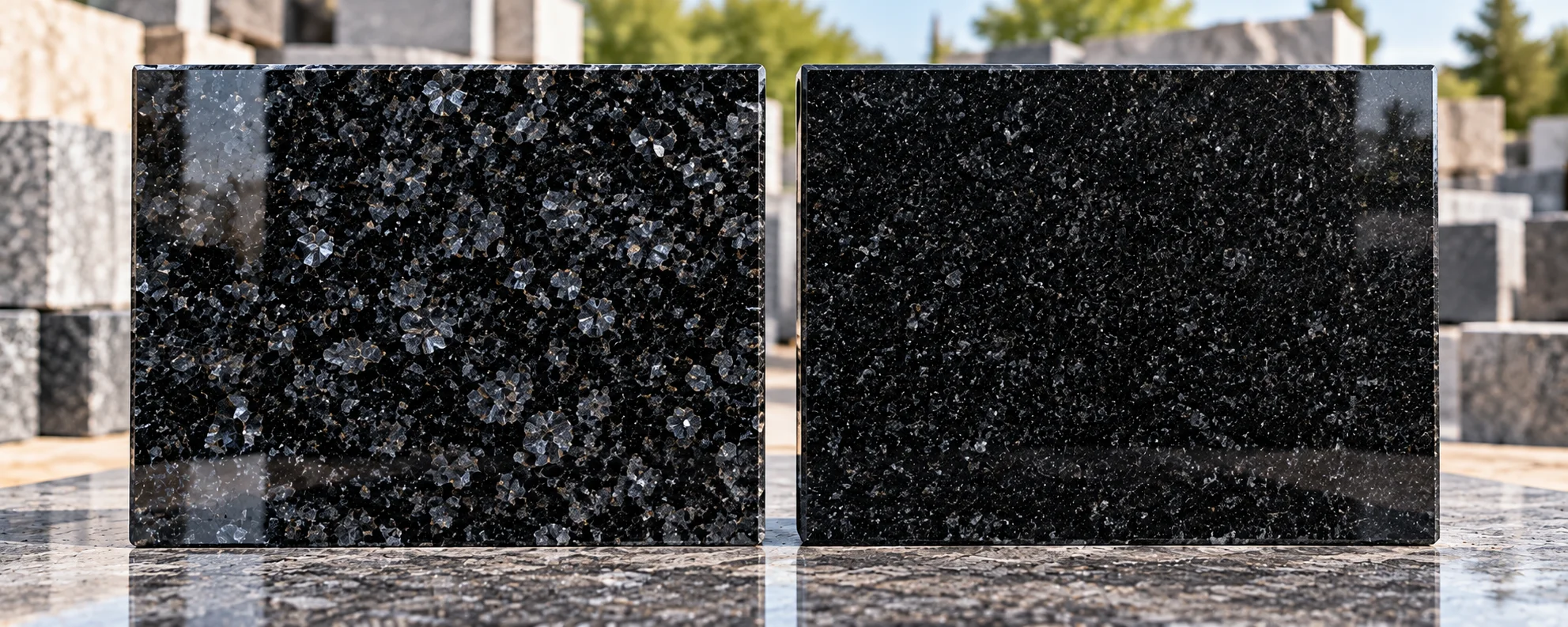
If the plot is in a pale grey or a speckled stone, a small drift hides inside the pattern. Black is the opposite. A mirror-polished black face is an almost uniform surface, so any difference in depth of colour has nothing to hide behind.
There is a second effect that catches people out: the same block polished on two different days can look different if the polish is not taken to the same level. A slightly under-polished face reads lighter and slightly grey. So “same block” is necessary but not sufficient — the finish specification has to be identical across the set as well, and written on the drawing face by face.
The fix is boring, which is why it works
Reserve the stone for the whole plot before anything is cut.
That is the entire technique. When an order comes in for a monument, we ask what else the plot needs — kerbs, cover, vases, lantern, plaque — and hold blocks for all of it in one go. The monument gets cut from the body of the block; the vases and the lantern get turned from the offcut that would otherwise go to waste. Same block, same run, same polish line, same week.
It costs nothing extra. It is simply a decision that has to be made before cutting rather than after, and that is the only reason it gets missed.
What to do when the family orders in stages
This is the real-world problem, and pretending otherwise would be useless. Families often cannot pay for a whole plot at once. The monument goes up first; the surround follows next season; the second inscription comes years later.
Take a common example: a workshop takes an order for a double monument where only one name is to be cut now. The second name, and the kerb set, will follow — maybe in a year, maybe in five.
Three things make that work:
- Cut the whole set now, ship it in stages. The cost is storage, which is cheap. The benefit is a plot that matches forever. For a workshop with any yard space, this is almost always the right answer.
- Or reserve the block and record the number. If cutting everything now is not possible, the block run can be recorded against the job so the later pieces come from the same reservation. Ask your supplier whether they actually keep that record — many do not.
- Keep the lettering layout on file. A second inscription has to match the first in font, spacing and depth, not just the font name. Depth is the one everyone forgets, and it is the one that shows in raking light.
What this is worth commercially
Workshops sometimes read all this as a supplier trying to enlarge the order. It is worth putting the commercial side plainly instead.
A matched plot is the single easiest thing to photograph well, and memorial work sells on photographs — in the showroom, in the catalogue, on a phone at the kitchen table. A set that matches looks like craftsmanship. A set that does not looks like assembly, and the family cannot tell you why, but they feel it and they repeat it to the next family.
There is also a quieter benefit. When the fittings come from the same supplier as the monument, there is one drawing, one proforma, one packing list and one crate number to chase if something is missing. Workshops that have spent a Friday afternoon trying to work out which of three suppliers has the second vase do not need this explained.
Five questions to ask before you split an order
- Will the monument and the kerbs come off the same block run? If the answer is vague, assume no.
- Is the polish specification the same on every piece? It should be written face by face on the drawing.
- Is the block number recorded against this job? This is what makes a later addition possible.
- Is the lettering layout kept on file, with the depth? Font name alone is not enough.
- Can the whole set be cut now and shipped in stages? Usually yes, and it is usually the right call.
Frequently asked questions
Does ordering the whole plot together cost more?
No — in most cases it costs less per piece, because the vases and lantern are turned from the offcut of the monument’s own block rather than from fresh material. What changes is the timing of the decision, not the price.
How different can two blocks of the same stone really be?
Enough to see when they sit side by side, and not enough to see when they are apart. That is precisely what makes it dangerous — the samples look fine in the showroom and the problem only appears once the plot is assembled at the cemetery.
We buy vases from stock. Is that a problem?
Only if they end up on a plot whose monument came from elsewhere. Many workshops keep stock vases for repairs and replacements and order matched vases with each new monument. Both can be true at once.
The family wants to add a lantern in two years. What should I do now?
Either cut it now and store it, or have the block number recorded against the job so the later piece comes from the same reservation. Decide which at the time of the first order — not when the family calls back.
Does this apply to grey and coloured granite too?
Yes, but with less severity. Speckled and veined stones hide small drift inside their own pattern. Uniform blacks hide nothing, which is why this question comes up most on exactly the stones the memorial trade uses most.
Can a mismatch be corrected after installation?
Not really. Re-polishing can lift a dull face slightly, but it cannot change the colour of the stone. The honest answer is that the piece gets replaced — which is why the cheap split order is rarely cheap.
In short
A plot is not a monument with accessories. It is one object made of six pieces, and the only reliable way to make those six look like one object is to cut them from the same block run, to the same finish, at the same time.
Everything else — the carving, the lettering, the polish — is skill that a good workshop already has. This one is just a decision, and it has to be made before the saw starts rather than after.
Tell us what the whole plot needs, not just the monument. Kerbs, cover, vases, lantern and plaque get held on one block run and crated together, whether you ship it in one go or in stages.
Request a quotation


