Memorial products · Carved work
Khachkars in Granite: Carving Depth, Sizes and What Ships Safely
A khachkar is not a cross with decoration around it. It is a carved object with its own grammar, and most of what decides the price — and whether it survives the journey — is settled before a chisel touches the stone. Here is what we have learned cutting them for diaspora workshops and churches.
What we are actually making
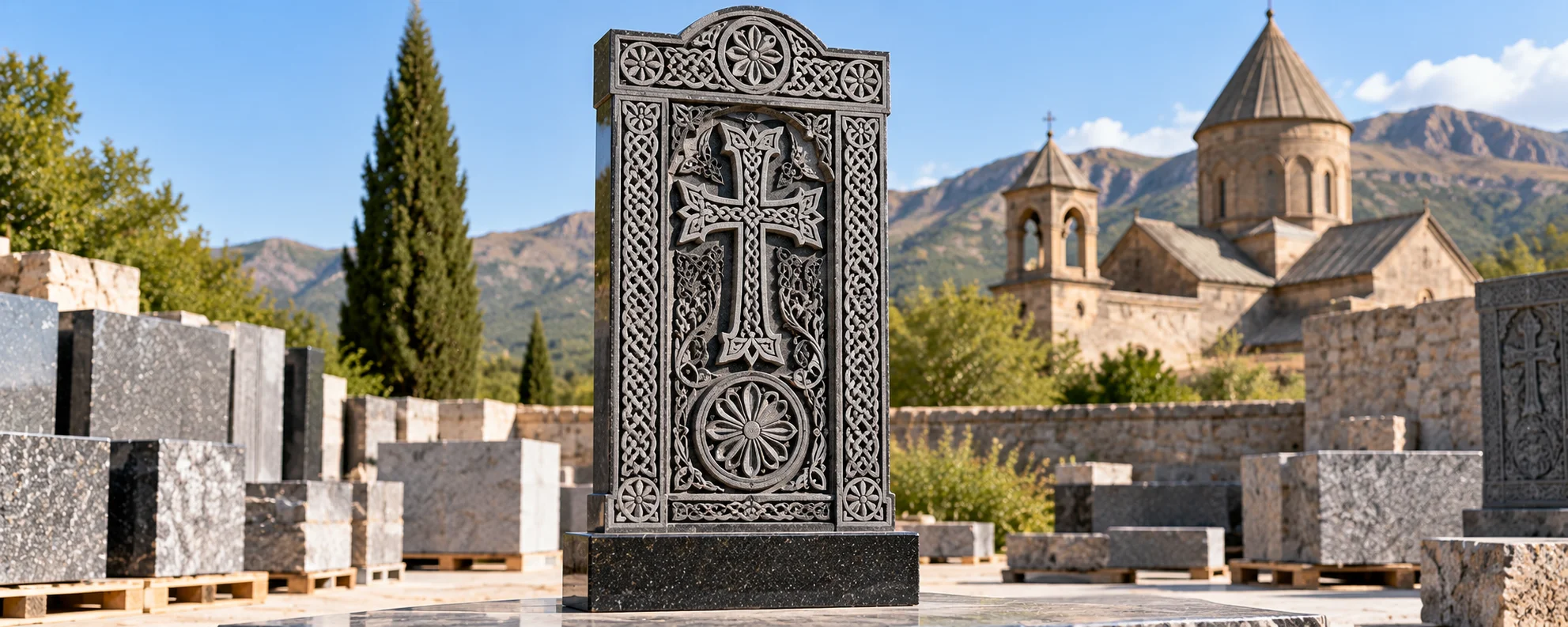
The khachkar — խաչքար, literally “cross-stone” — is one of the oldest continuous carving traditions in the Christian world, and UNESCO inscribed the art of the Armenian cross-stone on its list of Intangible Cultural Heritage in 2010. That is not a marketing line; it is the reason this work carries an obligation that an ordinary headstone does not.
We should be straight about our own role in that. We are stone cutters and carvers in Tamil Nadu, not Armenian masters, and we do not pretend otherwise. The design authority stays with you — the workshop, the church, the family. You send the drawing, the photograph of the khachkar it should follow, or the master’s design. We cut it, and our carvers finish the ornament by hand. What we bring is the stone, the plant and the hand-work; what you bring is the tradition.
The four elements, and why they matter to a quotation
Nearly every khachkar is built from the same vocabulary, and each element behaves differently under the chisel:
| Element | What it is | What it costs in work |
|---|---|---|
| The cross | The central form, often with flared or budded arms | Machine roughed, hand finished. Moderate — the arms must stay crisp |
| The rosette | The disc beneath the cross, read as the sun or the wheel of eternity | Slow. Curved relief inside a circle is the hardest form to keep even |
| The interlace | The woven field filling the panel around the cross | The real cost. Every strand crosses over and under, and the eye catches any break |
| The border and cornice | The frame, and the hood or cap at the top | Repetitive but exacting — a border that wanders is more visible than you expect |
When a quotation varies wildly between suppliers, it is almost always the interlace. Ask what depth it is cut to and whether it is machine-textured or genuinely hand-finished. Those are two different objects at a glance.
Carving depth: four levels, and how to specify yours
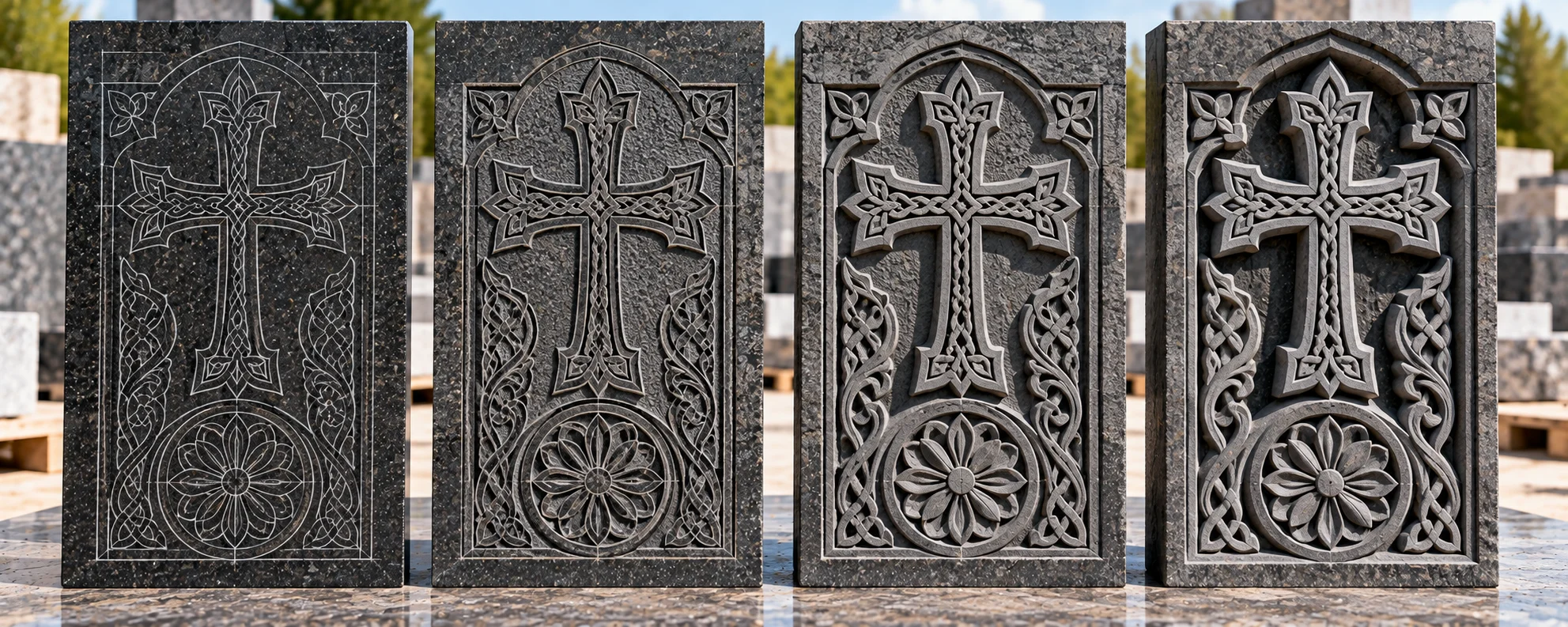
This is the single line most enquiries leave out, and the one that moves the price most. We quote against four levels, and they are easy to point at:
Plain cut
The profile is cut and polished, the cross is defined, and the field stays flat. No ornament. It is the fastest and cheapest route, and for a small memorial khachkar it can be entirely appropriate — a clean cross on a dark polished ground reads powerfully.
Outline carved
The pattern is cut into the face as incised lines. The design reads from a distance, the stone stays strong, and the cost is a fraction of relief. For plots where the khachkar sits among other memorials, this is often the sensible level.
Relief carved
The ground is cut back around the ornament so the interlace stands proud and throws a shadow. This is what most people picture when they say “khachkar”. It is mostly hand work, and it is where the carving shop earns its keep.
Deep relief and undercut
The strands of the interlace are undercut so they genuinely appear to pass over and under one another. It is the most beautiful and the most demanding, and it is also the level that needs the most thought about transit, because undercut stone has thin sections with air behind them.
Granite or tuf — an honest comparison
Traditional khachkars are carved in Armenian tuf, the soft volcanic stone that gives them their warm rose and amber colours. Tuf carves beautifully and quickly, which is part of why the tradition could reach the fineness it did.
Granite is a different proposition and it is worth being clear about the trade:
- Granite takes far longer to carve. A relief that takes days in tuf takes considerably longer in granite. That is the honest reason granite khachkars cost what they cost.
- Granite survives harder climates. In northern Europe, Russia or Canada — freeze-thaw, road salt, acid rain — a dense granite holds a carved edge for far longer than a porous stone will.
- Granite reads darker and more formal. If the piece is meant to sit with other memorials in a cemetery, that often suits. If it is meant to look like a khachkar from Armenia, tuf’s colour is part of what you are remembering.
We cut granite. If what the commission really needs is tuf, we would rather say so than sell the wrong stone — and for diaspora work where the piece stands outdoors in a cold climate, granite is usually the right call anyway.
Sizes that actually get ordered
Khachkars span everything from a small plaque to a monument several metres tall. In practice the enquiries we see fall into three bands:
| Band | Typical use | What to watch |
|---|---|---|
| Memorial scale | A grave plot, a family memorial | Cemetery rules usually cap height — send the rule sheet with the enquiry |
| Church and courtyard scale | Church grounds, community centres, parish gardens | Foundation and anchoring become part of the drawing, not an afterthought |
| Commemorative scale | Public memorials, anniversary commissions | Block availability, crate weight and the crane at the other end |
Rather than quoting standard sizes, we work from your drawing — but send height, width, thickness and the intended base together. Thickness is the one people leave out, and it is what decides whether deep relief is even possible.
What ships safely, and what does not
A khachkar is the most fragile thing we routinely crate, and the fragility is concentrated in exactly the parts the carving makes beautiful. Three rules we apply without discussion:
- Thin unsupported sections do not travel. If a drawing produces a strand or a projection with nothing behind it, we flag it at the feasibility stage and suggest a change — a slightly thicker strand, or a shallower undercut in that one place. It is always cheaper to change a drawing than a block.
- The crate is built around the piece. Not a standard box with padding thrown in. Timber bracing shaped to the carving, fumigated to ISPM 15, faces boarded and the carved field protected separately.
- Lifting points are marked on the outside. Most damage to carved stone happens during handling at the receiving yard, not at sea. If your crew knows where to sling it, the problem disappears.
We also photograph the piece at roughing, at detail and in its crate before the container is sealed. On a one-off carving there is no second copy to compare against, so the photographs do the job a sample would normally do.
Armenian lettering and inscriptions
Inscriptions are cut in Armenian script from your artwork, sandblasted or engraved, painted, gilded or left natural. Two requests that save everyone trouble:
- Send the text as a document, not as a photograph. Retyping from an image is exactly where errors enter, and in a script our team does not read natively, a transcription error is invisible to us and glaring to you.
- Send fonts outlined in a vector file if the lettering follows a specific hand. The layout comes back at full size for signature before anything is blasted.
How to brief a khachkar commission
The enquiries that produce the best work arrive with four things:
- Photographs of the khachkar it should follow — four angles if you can, and at least one raking-light shot that shows the depth of the ornament.
- Sizes, including thickness, and whether it stands on a base or into a foundation.
- The carving level — plain, outline, relief, or deep undercut.
- The inscription text, as a document, with any emblem artwork as vectors.
From that we come back with a feasibility note first — what the stone will hold and what it will not — and then a drawing and a price. In that order, because a quotation against a drawing that cannot be cut helps nobody.
Frequently asked questions
Can you carve a khachkar from a photograph?
Yes, and most commissions start that way. Four angles are far better than one, and a raking-light photograph tells us more about depth than any written description. We return a drawing for your approval before cutting.
Is granite suitable, or should it be tuf?
For outdoor work in cold or polluted climates, granite holds a carved edge far longer. Tuf is the traditional stone and carves faster and finer. If colour and tradition matter more than durability, tuf is the honest answer — we cut granite and will say so.
How is the price decided?
Size, carving level and how much of the work is hand-finished. The interlace is the biggest variable by a wide margin, which is why the carving level should be stated in the enquiry.
Can it be cut from a single block?
Wherever the block allows, yes — a khachkar is traditionally one stone and we keep to that. Where size makes it impossible, joints are dowelled and placed on the back face, never through the carved field.
Who carves it — your own team or a subcontractor?
Our own carvers, in our own shop. Machines rough the form out; the cross, the rosette and the interlace are finished by hand, because that is the only part of this work a machine cannot finish convincingly.
How is it packed for shipping?
Crates are built around the piece with timber bracing shaped to the carving, fumigated to ISPM 15, carved field protected separately, crate weighed and lifting points marked outside. Photographs of the piece and the sealed container travel with the documents.
In short
A khachkar order comes down to four decisions: the design you are following, the stone, the carving level, and whether the drawing produces anything too thin to survive a container. Settle those and the rest is craft and scheduling.
What we would ask of any workshop commissioning this work — from us or from anyone — is to treat the carving level as a specification rather than a hope. It is the difference between a price you can compare and a price you cannot.
Send the photographs and the sizes. You will get a feasibility note on what the stone will hold, then a drawing, then a price — in that order.
Request a quotation


