Engraving & finishes · Portraits
Portrait Etching on Black Granite: Preparing Photographs That Survive Cutting
An etched portrait is only ever as good as the photograph it came from — and families almost always bring the wrong one, for the most understandable reasons. This is the article to send them before they start looking.
What etching actually does to the stone
It helps to understand the mechanism, because everything else follows from it.
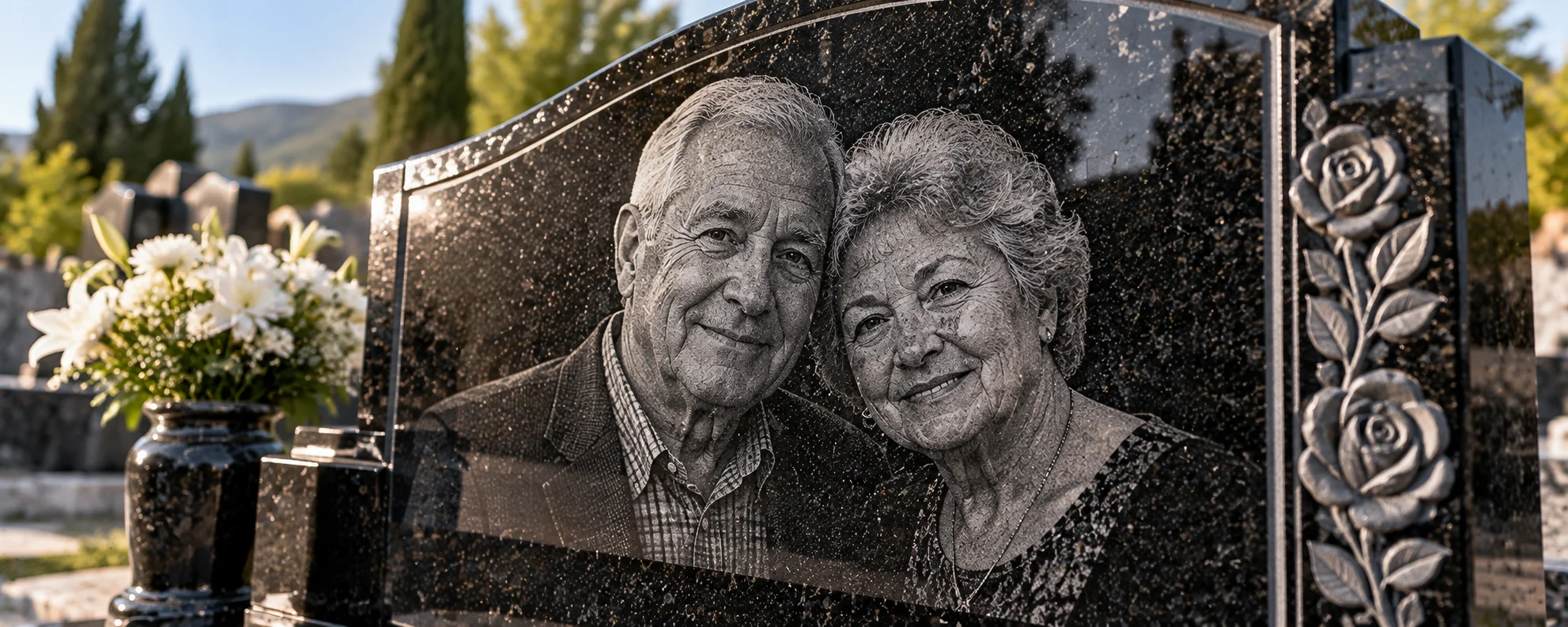
A polished black granite face is almost a mirror. Etching — by hand with a carbide point, or with a laser — removes that polish in thousands of tiny dots. Where the polish is gone, the stone scatters light and reads white. Where it remains, the stone reads black. There is no pigment, no ink and no paint involved. The whole portrait is made of black polish and white damage, and the grey tones are nothing more than how densely those white points are packed.
Two consequences fall straight out of that:
- Contrast is everything. The stone can only give you one white and one black. A photograph with no real blacks and no real whites has nothing for the stone to work with.
- Detail cannot be invented. If the eyelashes are not in the original file, they cannot appear in the stone. Enlarging a small image makes it bigger, not better.
The photograph families usually bring
Nearly every workshop has had this conversation. The family arrives with one of these, and each one causes a specific problem:
| What they bring | Why they bring it | What it does to the etching |
|---|---|---|
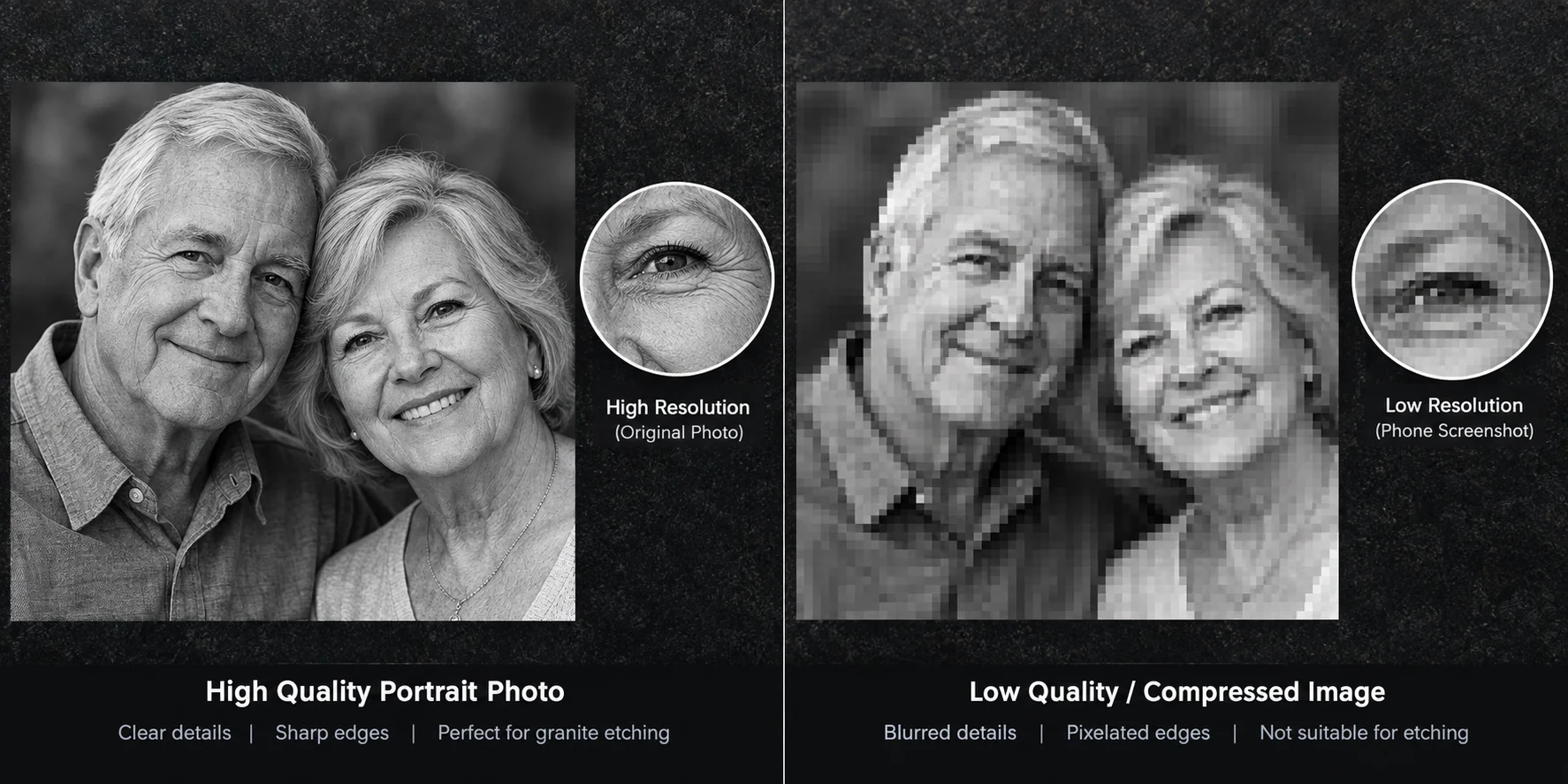
| A screenshot from a phone | It was the easiest to find | Far too few pixels. Soft everywhere, and the face goes doughy |
| A photo from social media | It is the picture everyone knows | Heavily compressed. Blocky artefacts appear as grey mush around the eyes |
| A group photo, cropped | It is the last good picture of them | The face occupies a few hundred pixels — not enough for a portrait at any size |
| A flash photograph | It was taken indoors at an occasion | Flat lighting. No modelling on the cheeks, so the face loses its shape |
| A heavily filtered photo | It is the most flattering one | Smoothing removes skin texture, and the portrait ends up looking like a mask |
None of this is the family’s fault. They are not choosing a technical file; they are choosing how they want to remember someone. The job of the workshop is to ask for the right thing kindly, and early — before the stone is ordered, not after the proof comes back.
What a good original looks like
Five things, and they are easier to explain in person than they look on a list:
1. The original file, not a copy of a copy
Ask for the file straight from the phone, camera or scan — not a version that has been sent through a messaging app, which recompresses it every time. If the only copy is a print, scan it at high resolution rather than photographing it.
2. The face filling a good part of the frame
What matters is not the size of the photograph, it is how many pixels are on the face. A large image of a whole wedding party gives less usable data than a small, sharp head-and-shoulders.
3. Soft, directional light
Daylight from a window is ideal. You want gentle shadow under the cheekbone and the nose, because that shadow is what gives the face its shape in stone. Direct flash flattens exactly the information the etching needs.
4. Sharp eyes
If the eyes are sharp, the portrait will carry. If the eyes are soft, nothing else will save it. This is the single fastest test for any candidate photograph: zoom to the eyes at full size and look.
5. Full tonal range
Some genuine dark and some genuine light in the picture. A photograph that is entirely mid-grey — an overcast day, a washed-out print — gives the stone nothing to separate.
What we can fix, and what we cannot
Retouching before etching is normal and expected. Being honest about its limits saves a difficult conversation later.
| Usually fixable | Not fixable |
|---|---|
| Removing a background, or another person’s shoulder | Softness and camera shake |
| Adjusting contrast and tonal balance | Missing resolution — detail that was never captured |
| Cleaning scratches, creases and dust on an old print | Heavy compression damage around the eyes and lips |
| Evening out blotchy colour on a faded photograph | Flat, shadowless light on the face |
| Opening a collar, tidying stray hair | A face that is simply turned too far from the camera |
Where a photograph sits in the second column, say so at the enquiry stage. A family is far more forgiving of “this one will etch better than that one” today than of a disappointing proof in three weeks.
Stone: why portraits live on black
Portrait etching needs a dark, fine-grained, mirror-polished face. Three reasons:
- Contrast. The whiter the etched dots read against the ground, the more tonal range the portrait has. Black gives the widest range available.
- Grain. A fine, even crystal holds the mid-tones of a face. A coarse or speckled stone interrupts them — which is why a beautiful stone like Black Galaxy is a poor choice for a portrait, however well it sells for everything else.
- Flat polish. An unevenly polished face reads as patches of lighter grey, and those patches sit across the portrait regardless of what the image is doing.
In practice almost all portrait work goes onto Absolute Black or an equivalent dense black. If a family has set their heart on a lighter or figured stone, the honest options are a portrait on an inset black panel, or a different technique altogether.
Size, distance and what the eye can resolve
A portrait that looks right on a desk can look crude at the graveside and vice versa. Two practical rules:
- Judge the proof at the size it will be cut, printed on paper, not on a screen. Screens flatter everything.
- Think about viewing distance. A memorial is usually read from a metre or two. Very fine detail that is invisible at that distance adds cost without adding anything the family will ever see.
Larger portraits are not automatically better. A smaller, well-lit, sharply focused head carries further than a large soft one.
How the proof stage works
Every portrait goes back to the workshop as a full-size proof before anything touches the stone. That is not a formality — it is the only point at which anything can still be changed.
When the proof arrives, check in this order: the eyes, then the mouth, then the hairline, then the collar. That is roughly the order in which a viewer’s eye will travel, and it is the order in which errors matter. Family members are very good at noticing something is wrong and very bad at saying what — so ask them to look at one feature at a time.
Outdoors: what happens over twenty years
Etching is shallow by its nature — a surface technique, not a cut into the stone. That has implications worth explaining to a family up front rather than apologising for later:
- On a sheltered face, in a covered niche or a chapel, an etched portrait holds beautifully for decades.
- On a fully exposed face in a wet, freezing or polluted climate, it is the first element of a memorial to soften.
- Cleaning matters more than weather. Abrasive pads and household scouring products damage etching permanently. Water and a soft cloth, nothing else.
Where a memorial stands fully exposed and the family wants the portrait to outlive them, a deeper-cut alternative — a carved relief, or a portrait on a replaceable inset panel — is worth putting on the table.
A short script for the counter
Workshops have asked us for the actual words. Something like this works:
“The portrait is made by removing the polish from the stone, so it only has black and white to work with. Could you look for the sharpest photograph of them rather than the most recent — ideally the original file from a phone or camera, with their face taking up most of the picture, and taken near a window rather than with a flash. Bring two or three and we will tell you which will etch best. Nothing gets cut until you have approved a full-size proof.”
Frequently asked questions
What resolution does the photograph need to be?
Rather than a number, the test that works: open it at full size and zoom to the eyes. If the eyelashes and the catchlight in the eye are clearly defined, the file is good enough. If they smear, no amount of processing will recover them.
Can you work from an old or damaged print?
Often yes, and old prints are frequently better than modern phone images because they were taken with proper lighting. Scan the print at high resolution rather than photographing it. Scratches, creases and fading are usually repairable.
Can two people be etched on one memorial?
Yes, either as two separate portraits or as one combined image. If the source photographs differ in lighting and sharpness, say so early — matching two very different originals is the hardest retouching job there is.
Will the portrait fade?
There is no pigment to fade, but the etched surface does weather. Sheltered, it lasts decades. Fully exposed in a harsh climate, it softens over time. Abrasive cleaning causes far more damage than weather does.
Can a portrait be etched onto grey or coloured granite?
Technically yes, with much less contrast and a flatter result. For anything other than dark, fine-grained stone we would suggest an inset black panel instead, so the portrait keeps its tonal range.
Do you send a proof before cutting?
Always, at full size, before the face is touched. Check the eyes first, then the mouth, then the hairline. Nothing is cut until the proof comes back approved.
In short
Etching is a subtractive technique on a mirror. It can only give back what the photograph gave it, which makes the ten minutes spent choosing the right original the most valuable ten minutes in the whole job.
Ask for the sharpest file rather than the newest. Check the eyes at full size. Put a full-size proof in front of the family before anything is cut. Do those three things and portrait work stops being the part of the order you worry about.
Send the photograph you are unsure about. We will tell you honestly whether it will etch well, what we can repair, and what it will look like at the size you are planning — before you commit to the stone.
Send a photograph for assessment


