
Stone selection · Formats
Blocks, Slabs or Finished Units: Choosing Where to Buy in the Chain
The same granite is sold five different ways, at five different points of its own production, priced in five different units. Pick the wrong one and every quotation you receive afterwards becomes impossible to compare. Here is how to decide where you should be buying.
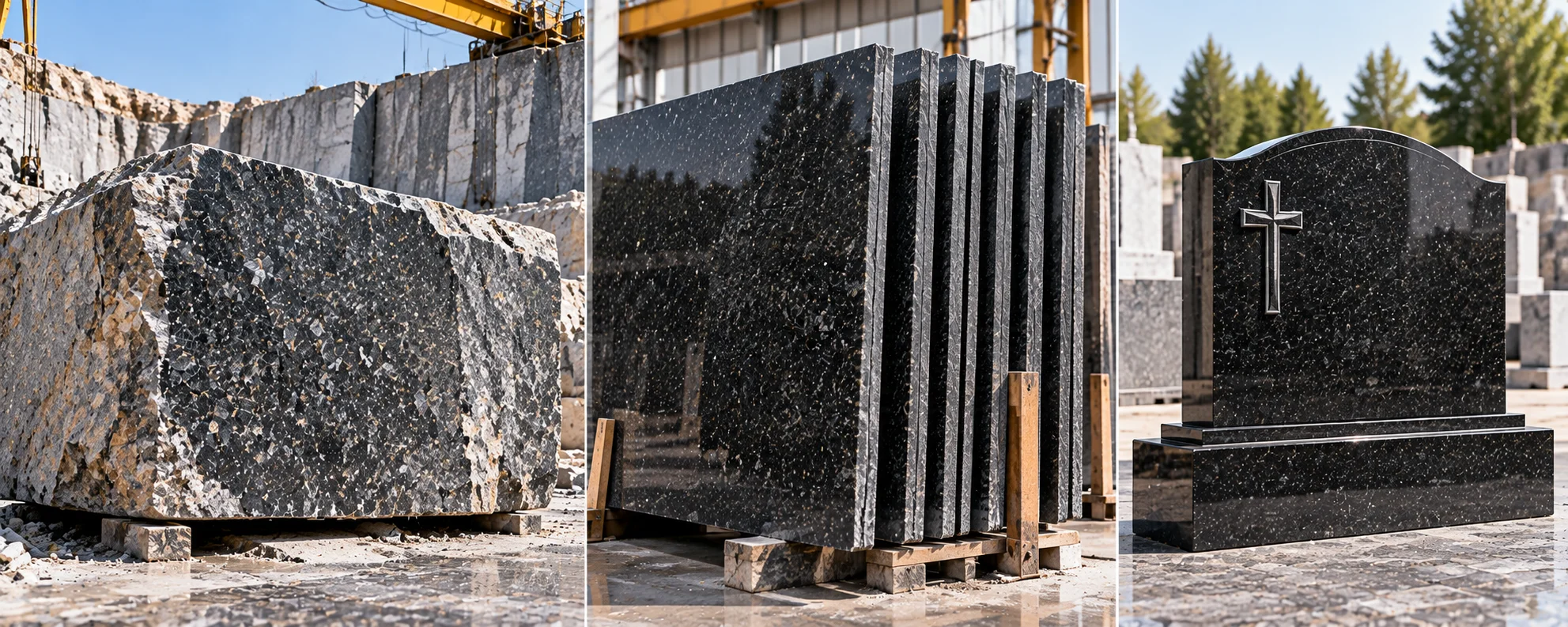
The five formats, and what each is priced in
Before anything else, the vocabulary — because most confused quotations start here:
| Format | Priced in | Who it suits |
|---|---|---|
| Quarry blocks | Per cubic metre | Plants with their own gangsaw |
| Gangsaw slabs | Per square metre | Workshops with a bridge saw and polishing line |
| Cutter slabs | Per square metre | Workshops cutting to size but not sawing blocks |
| Cut-to-size / blanks | Per piece | Workshops that letter and finish but do not cut shapes |
| Finished units | Per piece | Dealers and retailers with no plant at all |
Two quotations only compare when the format and the unit match. A square-metre rate for slabs and a piece rate for finished monuments are not the same number and never will be. If you take one thing from this article, take that.
Blocks: the cheapest stone and the most expensive mistake
Buying blocks gives you the lowest cost per cubic metre of material, full control over how it is cut, and the ability to decide thickness and yield yourself. For a plant with a gangsaw running regular shifts, it is usually the right place to buy.
What people underestimate is everything that comes attached to it:
- You buy the whole block, including what you cannot use. Yield depends on your own cutting plan, and a block that looks magnificent in the yard can produce less usable material than expected once the first slabs come off.
- Blocks are heavy and freight is weight-limited. You are shipping a great deal of material you will later turn into offcut and slurry.
- The quality decision moves to you. Cracks, seams and shade drift are yours to judge at the quarry face or on arrival — not the supplier’s to absorb.
- Working capital sits still. A block in your yard is money not moving until it is cut, polished and sold.
None of that is an argument against buying blocks. It is an argument for buying them only if the saw is already there and already busy.
Slabs: where most workshops actually belong
Gangsaw slabs come off the block at full block width; cutter slabs are smaller sheets cut to a working size for your own line. Both let you keep the shaping, polishing and lettering margin inside your workshop while handing the heaviest, dirtiest stage to the supplier.
Two things to insist on, whichever you buy:
- Sequence numbering. Slabs should be numbered in the order they came off the block so a batch stays together through your own cutting. Without it, a plot assembled from the same delivery can still end up mismatched.
- A clear line on cutting waste. Ask whether the square-metre rate is quoted on gross slab area or on usable area. Suppliers differ, and the difference is real money.
Cut-to-size and blanks: the format most dealers under-use
This is the middle ground, and in our experience it is where a surprising number of buyers should be sitting without realising it.
Blank stock means shapes cut and polished to your specification and shipped with no lettering. You hold inventory, show the family a finished shape in the showroom, letter it in your own shop in days rather than weeks, and keep the lettering margin — which in most memorial businesses is the healthiest margin on the job.
It also protects you from the one thing that cannot be repaired. A misspelt name on a stone lettered eight thousand kilometres away is a replacement and a shipping cycle. A misspelt name on a blank in your own shop is an afternoon.
Finished units: when buying the end product is the right call
If you have no plant — or you have plant that is better used on something else — buying finished, lettered units is not a compromise. It is a different business model, and a perfectly good one.
It makes particular sense for:
- Carved work. Khachkars, crosses, figures and relief panels need carvers, not machines. Very few workshops have both.
- Structures. Chapels, mausoleums and columbaria that are dry-built at the works and crated in setting order.
- Lines you sell occasionally. Keeping skills and tooling for something you produce four times a year rarely pays.
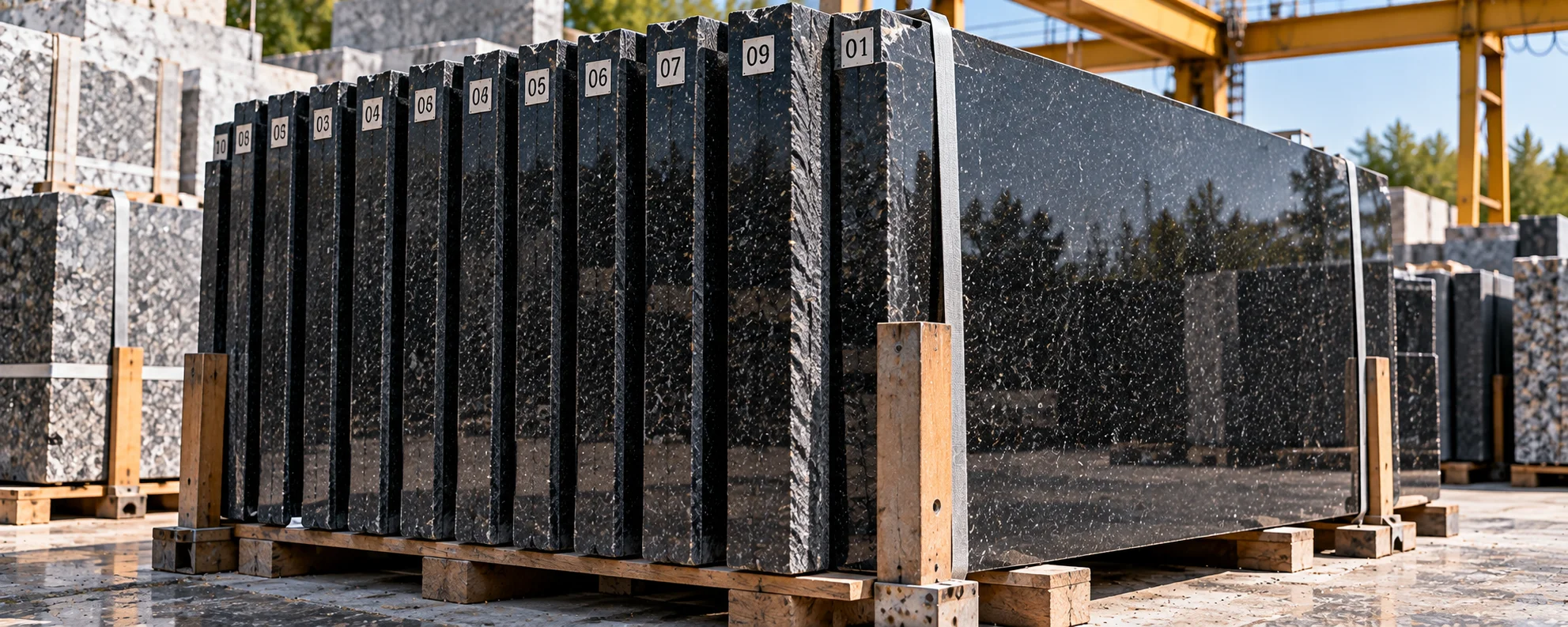
Which one are you? A short diagnostic
Four honest questions usually settle it:
- Is your saw running near capacity already? If yes, buy blocks or slabs — you are converting material into margin. If your saw sits idle half the week, the cheap stone is not cheap; it is just capital parked in your yard.
- Where does your profit actually come from? For most memorial businesses it is lettering, design and the relationship with the family — not sawing. Buy at the point that protects the profitable part.
- How fast do you need to turn an order around? Blank stock on the shelf beats any lead time from any supplier anywhere.
- What is your tolerance for yield risk? Blocks transfer that risk to you. Finished units leave it entirely with the supplier.
Most buyers should be in two formats, not one
Here is the pattern we see in workshops that run smoothly, and it is almost never a single format.
Take a typical memorial workshop with a bridge saw and a lettering bay but no gangsaw. The arrangement that works for them is usually: slabs for the volume shapes they cut week in week out; blank stock for the popular finished shapes so the showroom is never empty; and finished units for carved work and anything structural they cannot produce themselves. One container, three formats, each line marked and listed separately.
That mix also makes the first order far less of a gamble. Instead of betting on forty of one shape, you test a spread and let the season tell you what your market buys.
The freight arithmetic nobody mentions
Granite reaches a container’s weight limit long before it fills the space. That single fact changes the comparison between formats more than most buyers expect.
- Blocks carry the most dead weight — you are paying freight on material that becomes offcut.
- Slabs are the most efficient use of weight for a workshop that will convert them.
- Finished units carry the least waste but the most packing volume, because each piece needs protection.
Tell your supplier the weight limit at your port and ask for the loading plan to be built to it. If a line comes up short of a full load, it is easy to top up — and far better than paying for air.
Five questions to put on every enquiry
- Which format is this quotation for, and what unit is the rate in?
- Does the square-metre rate include cutting waste, or is it usable area?
- Are slabs sequence-numbered, and will a job be held to one block run?
- What is the container quantity these rates assume?
- Is the rate held once the proforma is issued?
Any supplier will answer all five in a few lines. How quickly and how plainly they do it tells you most of what you need to know.
Frequently asked questions
Is buying blocks always cheaper?
Per cubic metre of material, yes. Per finished piece sold, often not — because yield, freight on waste, sawing time and working capital all sit with you. It is cheaper only if your saw is already busy.
What is the difference between gangsaw slabs and cutter slabs?
Gangsaw slabs come off the block at full block width. Cutter slabs are smaller sheets cut to a working size for your own line. Gangsaw gives more flexibility and larger pieces; cutter slabs are easier to handle and reduce your own cutting.
What exactly is blank stock?
Shapes cut and polished to specification and shipped without lettering, so your own shop cuts the inscription. It shortens lead times dramatically and keeps the lettering margin with you — and a mistake becomes an afternoon rather than a replacement shipment.
Can I mix formats in one container?
Yes, and most sensible first orders do. Slabs, blanks and finished units travel together, each line marked and listed separately on the packing list.
How do I compare two suppliers fairly?
Put them on the same format, the same unit and the same container quantity before you look at the numbers. Then check whether the rate is held after the proforma. Those two steps remove almost all of the confusion.
Do I need to know my thickness before enquiring?
For slabs and tiles, yes — it drives the rate. For monuments and cut-to-size, no: those are quoted in finished dimensions, and the thickness follows from the drawing.
In short
Where you buy in the chain is not a procurement detail. It decides your freight, your yield risk, your lead times and which part of the margin stays in your own shop.
Buy blocks if your saw is already busy. Buy slabs if you shape and polish but do not saw. Buy blanks if your profit is in lettering — which, for most memorial businesses, it is. Buy finished units for carving and structures. And whatever you do, settle the format before you discuss the price, because until then nobody is comparing anything.
Not sure which format fits your shop? Tell us what machinery you run and what you sell most of, and we will quote the formats that actually suit it — including the mix, if that is the honest answer.
Request a quotation


