
Memorial products · Columbaria
Columbarium Cost per Niche: What Actually Drives the Price
Every columbarium enquiry starts with the same question and almost no supplier answers it honestly. Nobody can quote a cost per niche until four things are decided — so here are the four, in the order they matter, and how to get a real number quickly.
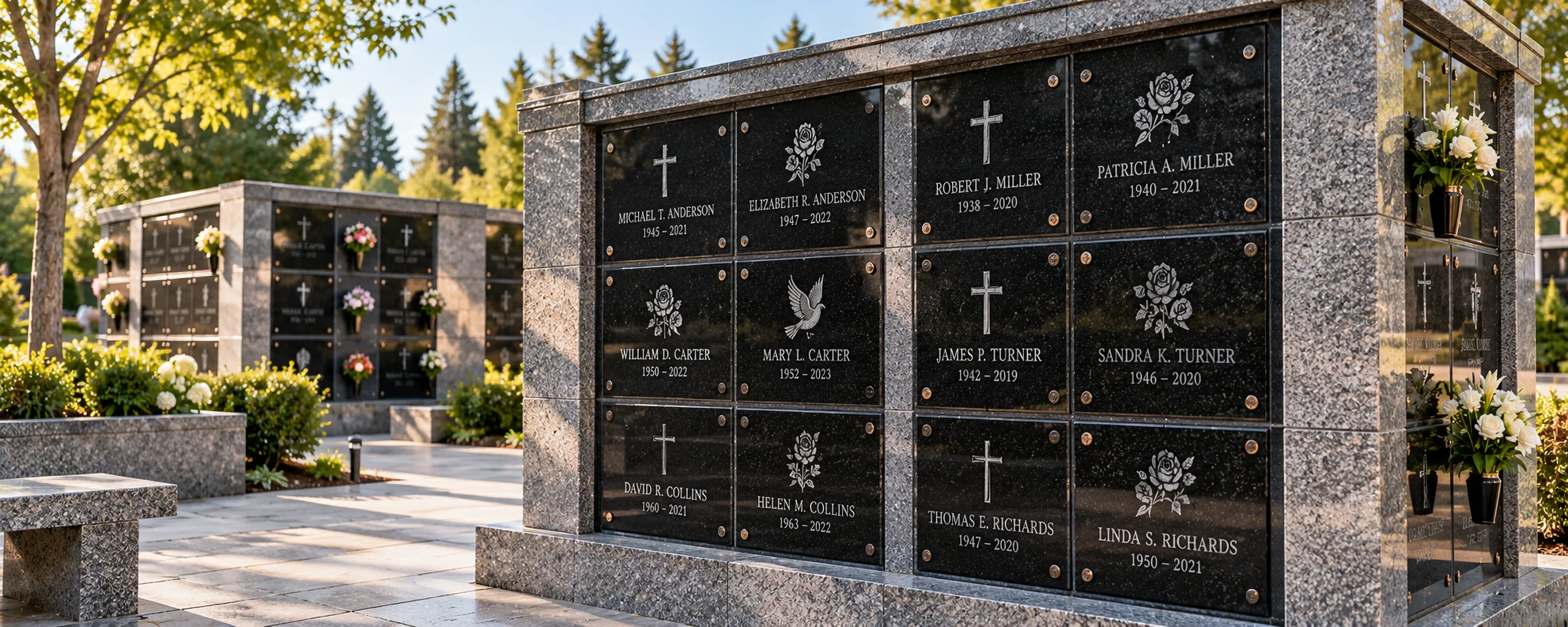
Why nobody publishes a price per niche
It is not evasion. A columbarium is not a product with a list price; it is an assembly whose cost moves with decisions the buyer has not usually made yet.
Two cemeteries ask for “a 48-niche columbarium”. One wants single-depth niches with granite fronts, set on an existing concrete pad, shipped blank for local lettering. The other wants companion niches, glass fronts, a bronze dedication panel, full engraving and a new foundation on a sloping site. Same niche count, and the two jobs are not in the same conversation.
If a supplier gives you a per-niche price before asking about front type and site, treat it as a sales number rather than a quotation. It will change.
The four things that actually move the price
1. Niche count — and the shape of the curve
Cost per niche falls as the count rises, because the fixed work — drawings, block reservation, setting out, crating, freight — spreads across more units. The drop is steep from a small unit to a medium bank, and then it flattens. Beyond a certain size you are mostly paying for material and engraving, and the savings become modest.
The practical consequence: a 24-niche unit is rarely twice the price of a 12, and boards that build the smallest possible first phase often pay the most per niche they will ever pay.
2. Configuration — what is behind the front
A niche is a cavity, and cavities cost differently:
- Single — one standard adult urn. The volume line in most banks.
- Companion — two urns side by side behind one front. Wider unit, one shutter, two names.
- Double depth — two urns front to back in a deeper cavity. Narrower elevation, more cutting.
- Family — four or more, with space kept for later inurnments.
Here is the part boards sometimes miss: companion niches lower your cost per interment even when they raise your cost per niche. If your market sells couples, counting niches is the wrong metric — count interments.
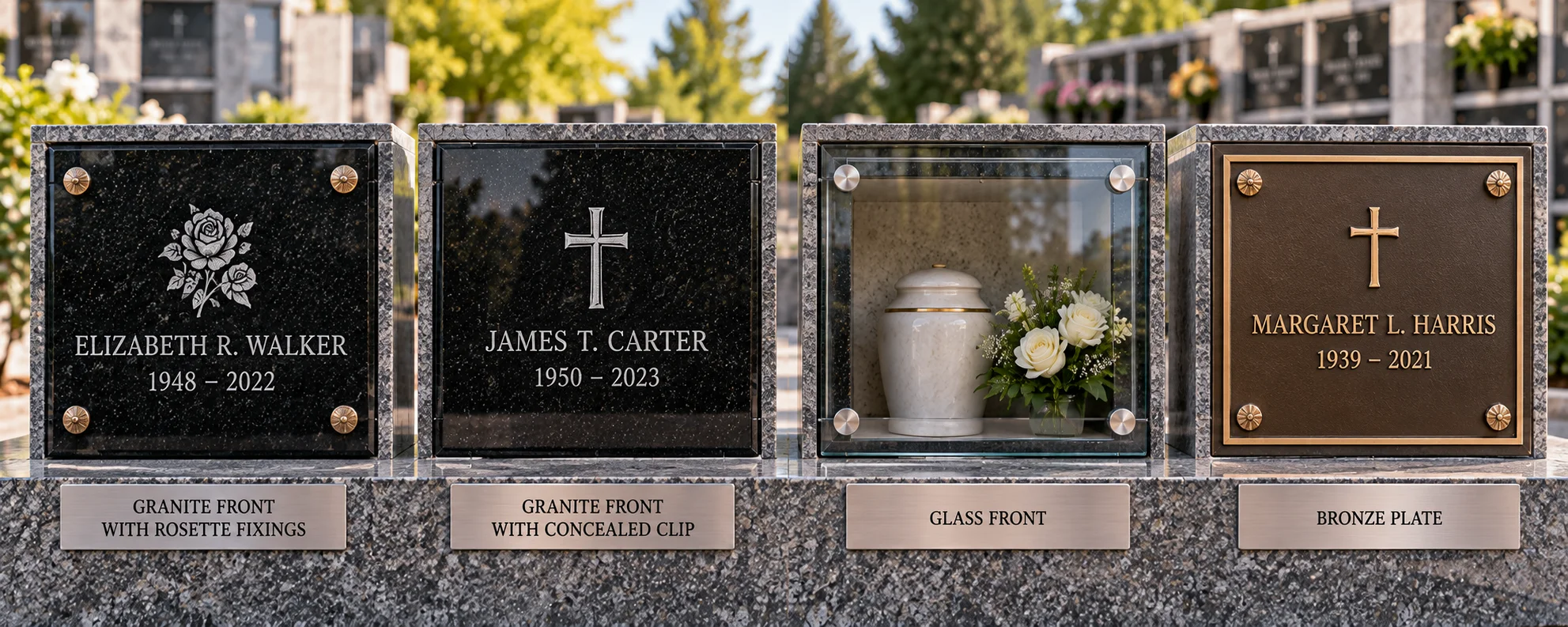
3. Front type — the biggest single variable
After the stone itself, this is where the money is:
| Front | What it gives you | Cost effect |
|---|---|---|
| Granite, rosette-fixed | Trade standard, easy to open for a second inurnment | Baseline |
| Granite, concealed clip | Cleaner face, no visible fixings | Slightly above baseline |
| Glass or acrylic | Urn and keepsakes stay visible | Higher, and adds a maintenance item |
| Bronze plate on granite | The look many memorial parks expect | Highest — bronze is a separate supply chain |
4. Engraving — or not
Fronts can ship blank and polished for your own shop or a local monument dealer to letter, or be engraved here from your schedule. Blank costs less and ships faster. Engraved here costs more and removes work from your side.
Most cemeteries we supply take a mixed approach: blank fronts as stock, lettered locally as each niche sells, with engraving done here only on dedication panels and signage. It keeps inventory flexible — an engraved front for a niche that has not sold is money sitting still.
The costs that are not on the quotation
A granite quotation covers the stone. A columbarium project covers rather more, and boards that budget only for the former get an unpleasant surprise. Account for:
- Foundation. Pad, footings, drainage and levels. On a sloping or soft site this can be a serious line.
- Setting. Crane or forklift hire, and a crew who have set stone before. Granite units are heavy, and the weights should be on your packing list before the container lands.
- Freight inland. Port to site, which on some routes is the roughest handling the stone will see.
- Landscaping. Paths, planting, benches, lighting — often a third of what families actually experience.
- Signage and dedication panels. Small cost, frequently forgotten until the opening ceremony is booked.
- Ongoing inscription work. Every sale brings a lettering job. Decide now whether that is yours, a dealer’s, or sent back to us.
Phasing: build the structure, release the niches
This is the single most useful piece of planning advice we can offer a board, and it costs us volume in year one.
Design the columbarium for its full eventual size. Reserve the granite for the whole thing on one block run. Then build and install in phases as niches sell.
Take a garden planned for 300 niches. Install 100 now, and hold the block reservation and the drawings for the rest. Three years later, phase two arrives matching phase one — same shade, same grain, same front detail, same letter height. A garden assembled from three different block runs looks like three projects standing next to each other, and families notice long before they can explain why.
Reserve for 300. Install 100. The reservation costs nothing like the stone does, and it is the only thing that makes phase three match phase one.
How boards usually model the return
We are stone suppliers, not financial advisers, and every cemetery’s figures are its own. But the structure of the arithmetic is the same everywhere, and it is worth setting out so you can fill in your own numbers:
- Total project cost — stone, foundation, setting, landscaping, signage.
- Divided by sellable interments, not niches. Companion niches change this number materially.
- Against your local selling price per niche or per interment, including the inscription fee if you charge one.
- Over a realistic sales period, not an optimistic one. Most gardens sell steadily rather than quickly.
With cremation now the majority choice across much of North America, demand for niches, urn plots and memorial walls has been growing while demand for full burial plots has not. That is the reason this question is being asked so often — and the reason phasing matters more than it used to.
What to send to get a real number in days
Five lines, and you will have a quotation you can take to a board meeting:
- Niche count, and the mix of single, companion and family if you know it.
- Front type — granite, glass or bronze, and fixed how.
- Blank or engraved, and who letters the sold niches afterwards.
- The site — a photograph and whether there is an existing pad.
- The programme — one phase or several, and roughly when.
If any of those is undecided, say so rather than guessing. We would rather quote two options plainly than one option built on an assumption nobody made.
Frequently asked questions
What does a columbarium cost per niche?
It depends on four things: niche count, configuration, front type and whether fronts are engraved or blank — plus foundation and setting at your end, which are not part of a granite quotation. A supplier quoting per niche before asking about front type and site is guessing.
Is it cheaper per niche to build a bigger columbarium?
Yes, up to a point. Fixed costs spread across more niches, so the cost per niche falls steeply from small to medium and then flattens. Very small first phases usually carry the highest per-niche cost a cemetery will ever pay.
Should fronts be engraved in India or locally?
Most cemeteries hold blank fronts and letter locally as niches sell, so inventory stays flexible. Engraving here makes sense for dedication panels, signage and fully pre-sold phases.
Can we add to a columbarium years later and still match?
Only if the granite was reserved on one block run and the drawings, block numbers and lettering layouts were kept on file. Ask any supplier whether they keep that record — it is what makes phase three match phase one.
What size are the niches?
Commonly 12 × 12 inches single and 12 × 24 companion, but the right answer is the urn dimensions your market actually uses. Send those and the cavity is sized around them; a non-standard size costs no more if it is set before cutting.
Who handles the foundation and installation?
Your contractor, locally. We supply setting drawings with piece weights, bearing loads and anchor positions so the pad can be poured before the container arrives, and crates numbered in setting order.
In short
Cost per niche is a real question with a real answer — but only after niche count, configuration, front type and engraving are settled, and only alongside the foundation and setting costs that no granite quotation includes.
If you are at the start of this, the most valuable decision is not the stone. It is to design and reserve for the full garden, then install in phases. Everything else can be changed later. That one cannot.
Send the niche count, the front type and a photograph of the site. You will get a written quotation with the container quantity, the crate weights and the setting drawings — the things a board actually needs to approve a project.
Request a quotation


