
Memorial products · Specification
Cremation Niche Sizes: Sizing the Opening Around the Urn
Most niche banks are specified the wrong way round — the opening is chosen first and the urn has to fit it afterwards. Here is how the dimensions actually work, why 200 cubic inches is the number everything hangs on, and what to confirm before a single front is cut.
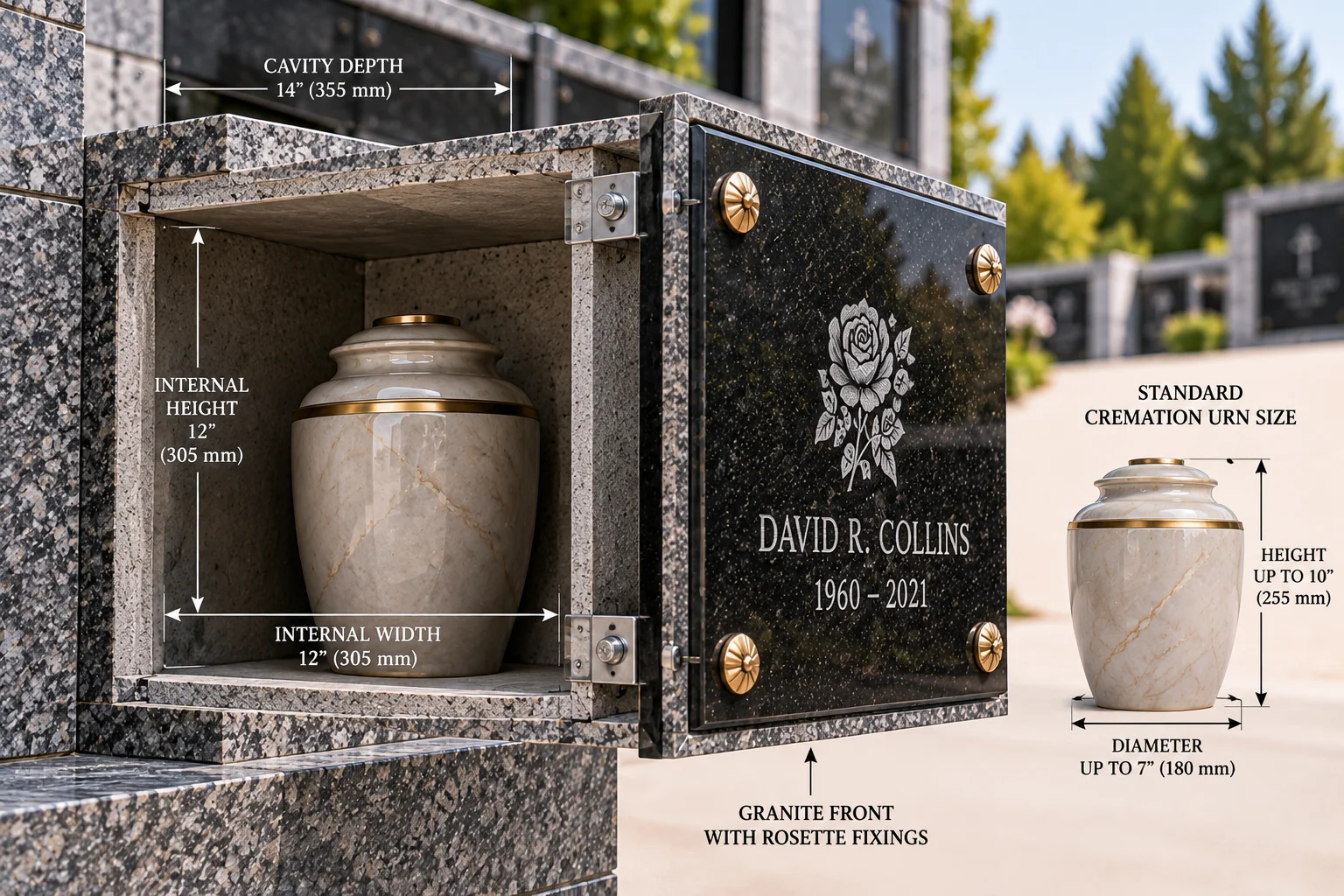
Start with the number everything is built on
In North America, urn capacity is quoted in cubic inches, and the convention the whole industry works to is roughly one cubic inch of capacity for each pound of healthy body weight. That is why 200 cubic inches is the standard adult urn size — it covers the large majority of adults with margin to spare.
From that single figure, the rest follows:
- Companion urns are commonly around 400 cubic inches, because they hold two.
- Keepsakes are small by design — a token portion for a family member.
- Oversize urns exist and are ordered more often than people expect. If your market sells them, the niche has to know about it.
Capacity is not shape. Two urns of 200 cubic inches can have entirely different footprints — a tall slim vase and a low wide box. A niche sized on capacity alone can still refuse the urn the family chose.
Three dimensions, and why people mix them up
| Dimension | What it is | What it governs |
|---|---|---|
| The opening | The hole in the face of the bank | What the front covers, and what you can physically pass through |
| The cavity | The space behind, including depth | What actually fits — height, width and depth together |
| The front | The shutter that closes it | Lettering area, fixing method, and whether it can be reopened |
The front is usually slightly larger than the opening, because it has to seat against the face. The cavity is usually slightly larger than the urn, because an urn has to go in and come out without scraping. When someone says “a 12 by 12 niche”, they almost always mean the opening — so ask which dimension they are quoting before you agree to anything.
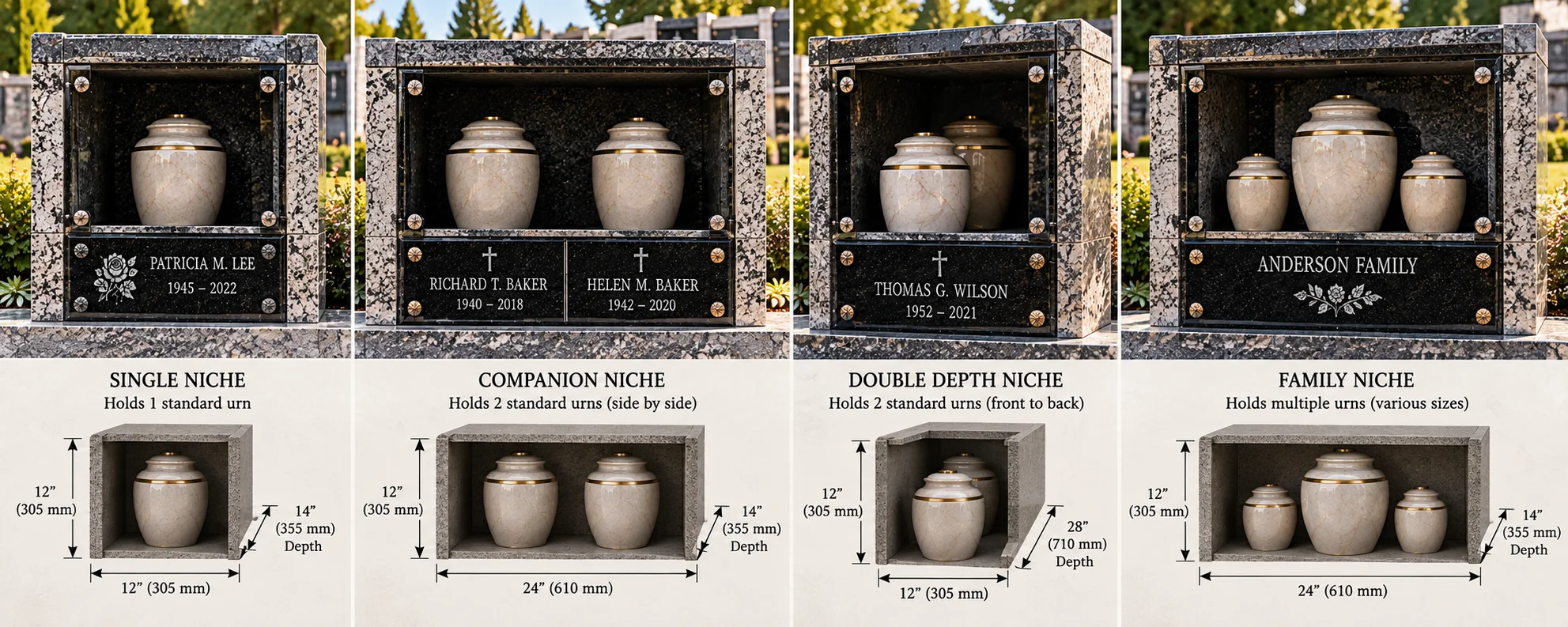
The four configurations
Single
One standard adult urn. Commonly a 12 × 12 inch opening, single depth. This is the volume line in almost every bank, and the one your pricing should be benchmarked on.
Companion, side by side
Two urns next to each other behind one front — commonly a 12 × 24 inch opening. One shutter, two names, and the family buys once. Wider elevation, so the bank is longer for the same number of interments.
Double depth
Two urns front to back in a deeper cavity, behind a single-width opening. Where wall length is constrained but depth is available, this is the configuration that saves the project. It needs more cutting and a deeper footprint, and the rear urn is only reachable when the front one is removed — which matters for the second inurnment.
Family
Four or more, in a larger cavity. Usually specified with deliberate spare capacity, because the whole point is that the family will come back. Size it for the urns they will buy in twenty years, not the two they are buying today.
Depth is the dimension that catches people
Height and width get specified. Depth gets assumed, and then an urn arrives that is 11 inches deep for an opening that is 12 inches square but a cavity that is 10 inches deep.
Three practical points:
- Allow clearance, not a perfect fit. A cavity cut to the exact urn dimensions is a cavity that fights the funeral director at the graveside, in front of a family.
- Think about hands. Someone has to place the urn and withdraw their fingers. That needs room the drawing rarely shows.
- Double depth needs honest depth. Two urns front to back plus clearance plus the thickness of the front: the wall gets deeper than most first drawings allow.
What to confirm before anything is cut
Send us these and the niche will fit the urn rather than the other way round:
- The urn you actually supply — dimensions in inches, or simply the model. Height, width and depth, not capacity alone.
- Whether families may bring their own urn. If yes, the cavity needs headroom for the largest thing your market reasonably sells.
- Whether a liner or insert is used. It adds dimension that is invisible in the catalogue photograph.
- Single or double depth, and whether companions are side by side or front to back.
- The front type and fixing — rosette, concealed clip, glass or bronze — since the front governs reopening as much as the cavity does.
Reopening: the dimension nobody draws
A niche is not sealed once. Companion and family niches are opened again, often years later and usually by someone who did not set them in the first place.
That has consequences for sizing:
- The front has to come off without damaging the face. Rosette screws are the trade standard precisely because they can be removed; adhesive-only closures cannot.
- In a double depth niche, the first urn has to come out before the second goes in — so the clearance has to work in both directions.
- Lettering added later must match the original in font, spacing and depth. Keep the layout on file at the time of the first inscription, not when the family calls back.
Standard sizes, and when to ignore them
Common North American sizes are 12 × 12 inches single and 12 × 24 companion. They are common for good reasons: they suit a 200 cubic inch urn, they stack into sensible bank elevations, and every local monument dealer knows how to letter a front that size.
But here is the thing worth saying plainly: a non-standard size costs no more, provided it is settled before cutting starts. Changing an opening on a drawing costs nothing. Changing it after the blocks are cut costs everything. If your market sells a taller urn or your architect wants a different elevation rhythm, say so at the drawing stage and it is simply a different number on the sheet.
Metric sites and mixed specifications
Plenty of projects run in millimetres — Canadian specifications, architect-led schemes, or cemeteries working from a European drawing set. That is no difficulty, but one rule prevents most errors: state the units on the drawing and keep the whole set in one system.
Mixed drawings — an elevation in millimetres and a niche schedule in inches — are the single most common source of sizing mistakes we see, and they are entirely avoidable.
Frequently asked questions
What is the standard cremation niche size?
Commonly a 12 × 12 inch opening for a single niche and 12 × 24 for a companion, sized around a 200 cubic inch adult urn. The right size, though, is the one that fits the urns your market actually sells.
Why is 200 cubic inches the standard urn size?
The industry convention is roughly one cubic inch of urn capacity per pound of healthy body weight, so 200 cubic inches covers the large majority of adults with margin. Companion urns are commonly around 400.
How deep does a double depth niche need to be?
Deeper than most first drawings allow: two urns front to back, plus clearance to place and remove each one, plus the thickness of the front. Send the urn depth and the cavity is worked back from it.
Can families bring their own urn?
Many cemeteries allow it, and if yours does, the cavity should have headroom for the largest urn your market reasonably sells rather than only for your own supplied model.
Does a non-standard niche size cost more?
Not if it is set before cutting starts — it is a drawing change rather than a machining problem. Changing it after blocks are cut is a different matter entirely.
How are niches reopened for a second inurnment?
Through the front, so the fixing method matters: rosette screws and concealed clips can be removed without damaging the face. Tell your supplier which method your crew prefers before the fronts are drilled.
In short
Sizing a niche is not complicated, but it is directional. Start at the urn, work outwards to the cavity, then to the opening, then to the front — and allow clearance at every step for the person who will actually place it.
Send the urn dimensions rather than the niche count and most sizing problems never happen. Send the niche count alone and you are asking a supplier to guess on your behalf, in a place where a mistake is visible to a family at the worst possible moment.
Send the urn you supply — height, width and depth. We will size the cavity around it, confirm the opening and the front on the drawing, and have both signed before anything is cut.
Request a quotation


