
Buying & shipping · Blank stock
Granite Monument Blanks: Holding Stock and Lettering in Your Own Shop
The retailers who sell fastest are rarely the ones with the best catalogue. They are the ones with polished stone already standing in the yard. Here is how blank stock works, what it does to your lead times and margin, and how to choose a first mix without guessing.
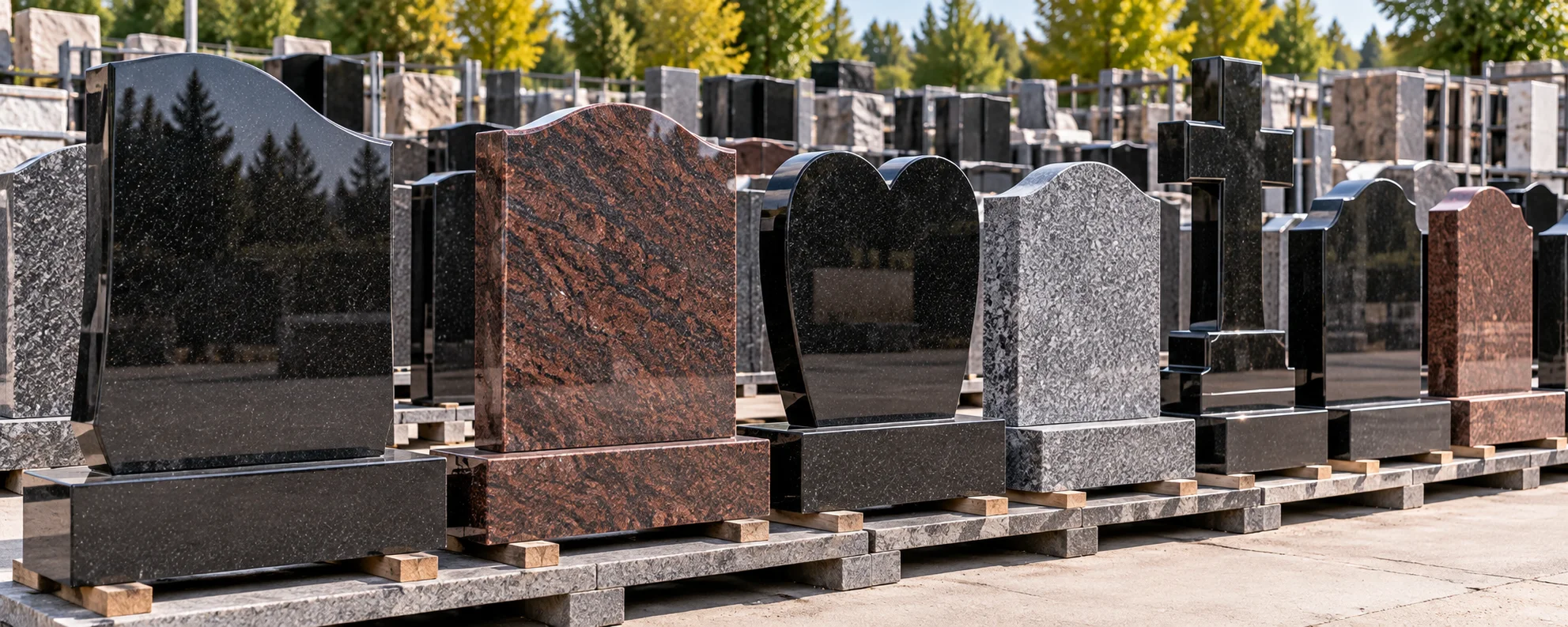
What a blank actually is
A blank is a monument that is finished in every respect except the inscription. The shape is cut, the faces are polished to specification, the edges are worked, the base is matched — and the front is left clean.
It is not an unfinished product and it is not a second. It is the same stone you would otherwise receive lettered, stopped one step earlier so the last step happens in your shop instead of across an ocean.
Why retailers move to blanks
The lead time problem disappears
A family walks in on Tuesday. If the monument has to be ordered, drawn, cut, lettered and shipped, you are quoting months. If the shape is already standing in your yard, you are quoting the time it takes your own sandblast bay to cut an inscription — and that is a completely different conversation to have with someone who has just had a death in the family.
Nothing a supplier does — no express freight, no priority slot — competes with stone that is already there.
The margin stays with you
In most memorial retail businesses, lettering, design and the relationship with the family are where the profit sits. Sawing and polishing are not. Blank stock lets you buy the part that is cheap to produce at scale and keep the part that is valuable in your own hands.
A mistake stops being a disaster
A misspelt name on a stone lettered eight thousand kilometres away is a replacement and a shipping cycle. The same mistake on a blank in your own shop is an afternoon. For many retailers, this alone justifies the switch.
The showroom does the selling
Families do not buy memorials from photographs. They stand in front of the stone, touch the polish, see the real colour in daylight. A yard with twenty finished shapes in four stones closes work that a catalogue cannot.
What you need in your own shop
Being honest about this matters, because blanks do not suit everyone:
- A sandblast bay or a laser, and someone who can lay out an inscription properly.
- Stencil and layout capability — in-house or from a local supplier who turns it around quickly.
- Yard space and handling. Blanks are heavy, and they need to be stored upright, stable and where a family can walk among them safely.
- Working capital. Stock is money standing still until it sells. That is the real trade-off, and the reason to start with a sensible quantity rather than a brave one.
If you have no lettering capability at all, finished units are the better route and we would say so. Blanks are for retailers who already letter, or who are ready to start.
Choosing a first mix
The most common mistake is buying depth instead of breadth — forty of one shape, on a hunch, because the per-piece rate looked good.
A better first container spreads across shapes, stones and sizes, so the season tells you what your market actually buys. Something along these lines:
| Line | Why it is in the mix |
|---|---|
| Two or three upright shapes | Serp top, oval top, flat top — the shapes almost every market sells, in your most common sizes |
| One distinctive shape | A heart, a book or a cross, in a small quantity — it sells the showroom as much as itself |
| Flat markers and slants | Where cemetery rules require them, these are steady volume rather than occasional |
| Matching bases | Ordered with the uprights, from the same block run — a mismatched base is the giveaway |
| Two stones, not five | A black and one contrast. Range comes later, once you know what sells |
Each line is marked and listed separately on the packing list, so what came in and what sold are easy to reconcile at the end of the season.
The specification that makes blanks worth holding
Stock is only an asset if every piece is interchangeable. Four things to settle before cutting:
- One block run per stone. If your twenty black uprights come off two different runs, half your yard does not match the other half — and a base will eventually end up on the wrong upright.
- Polish specification, face by face. Polished front, sawn back, rock-pitched sides — whatever your market expects, written on the drawing rather than assumed.
- Consistent base dimensions. If all bases are cut to standard sizes, any base fits any upright. That flexibility is most of the value of holding stock.
- Inches or millimetres, stated once. North American work is quoted in inches. Say so on the drawing and the whole set stays in one system.
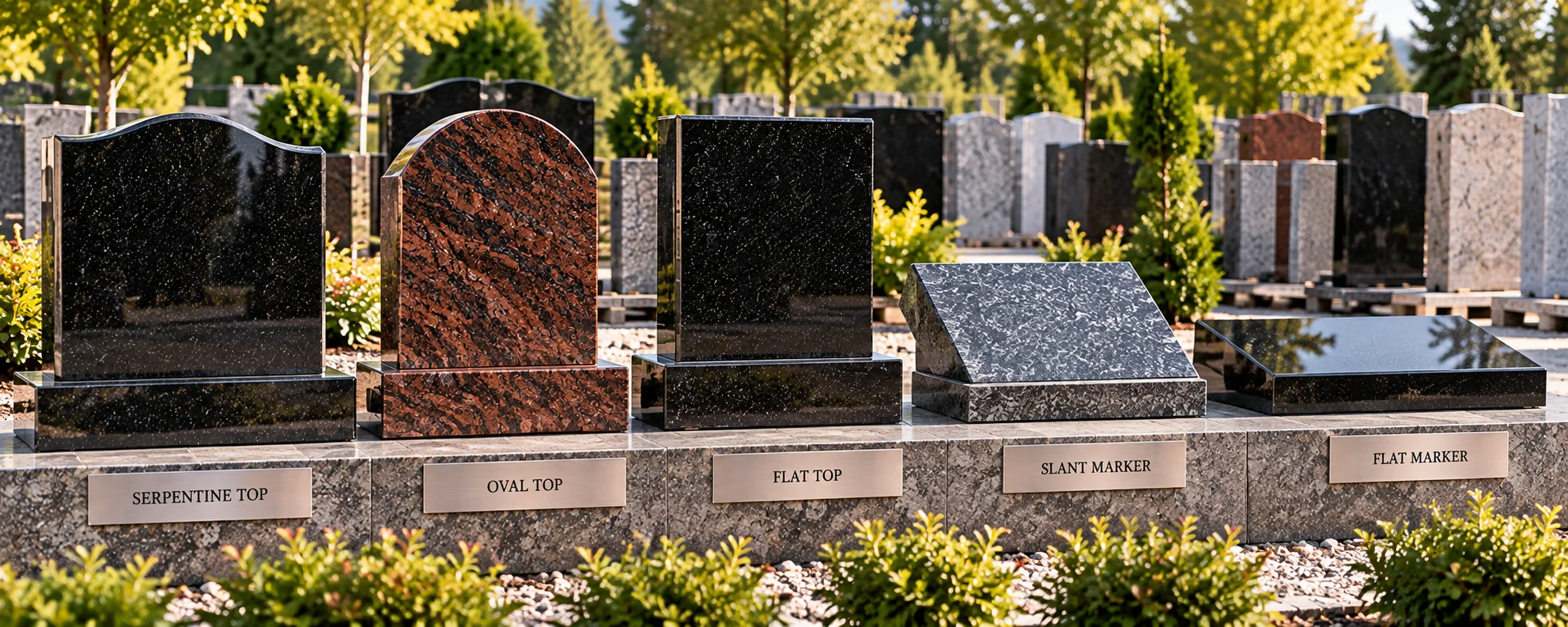
Cemetery rules decide more than taste does
Before you choose shapes, look at where your work actually goes. In much of North America the section decides the memorial, not the family:
- Some memorial parks permit flat markers only. Uprights will not be installed there whatever the family wants.
- Others cap height, width or base projection.
- Rules vary between sections of the same cemetery, not just between cemeteries.
Pull the rule sheets for the three or four grounds you serve most and let them shape the first order. It is unglamorous work and it prevents the most expensive kind of stock — stone you cannot install.
Reordering: the part that compounds
The first container teaches you something; the second is where blank stock starts paying properly.
By then you know which shapes moved, which stone your market prefers, and which sizes sat all year. Reorder the movers in depth, drop what did not sell, and add one new shape to test. Over three or four containers, your yard stops being a guess and becomes a reflection of your own market.
For that to work, the drawings, block numbers and base dimensions have to be kept on file so a reorder is genuinely a repeat rather than a redesign. Ask any supplier whether they keep that record — plenty do not.
Blanks or finished units — an honest split
| Take blanks for | Take finished units for |
|---|---|
| Standard uprights, slants and flat markers | Carved work — crosses, figures, relief panels |
| Your volume shapes and sizes | Structures: columbaria, mausoleums, benches |
| Anything a family may want quickly | Lines you sell only a few times a year |
| Stock you can letter in-house | Work needing skills or tooling you do not keep |
Most retailers end up running both, in the same container — blanks for the bread and butter, finished units for the pieces that need a carver.
Frequently asked questions
What is granite monument blank stock?
Monuments cut, shaped and polished to specification but shipped without lettering, so the inscription is cut in your own shop as each stone sells. The stone is identical to a lettered unit; only the last step moves.
How much stock should a first container hold?
Enough breadth to learn from, not enough depth to be stuck with. Two or three upright shapes, one distinctive shape, flat markers and slants if your cemeteries need them, matching bases, and two stones rather than five.
Will blanks from a second container match the first?
Only if the stone is held to one block run and the drawings and block numbers are kept on file. Ask about that before the first order — it is what lets a base from container two sit on an upright from container one.
Are blanks cheaper than finished monuments?
Per piece, yes, because the lettering is not included. Whether they are cheaper for your business depends on your own lettering cost and on the working capital tied up in stock — which is why the first order should be sized conservatively.
Can bases be interchangeable across shapes?
Yes, if they are cut to consistent dimensions from the start. That interchangeability is most of the practical value of holding stock, so it belongs on the drawing rather than being assumed.
What if a cemetery rejects a shape we have in stock?
That is why rule sheets should come before shapes. Pull them for the grounds you serve most and build the first order around what can actually be installed there.
In short
Blank stock moves one step of production from your supplier into your own shop — the step that carries your margin, your speed and your risk of a mistake you cannot fix remotely.
Buy breadth before depth. Hold each stone to one block run. Cut bases to consistent sizes so anything fits anything. Pull the rule sheets before choosing shapes. Do those four things and the second container will be a far better one than the first — which is exactly how this is supposed to work.
Tell us which shapes and stones you sell most, and which cemeteries you serve. We will put together a first mix built for your market, with bases cut to one standard and every line held on a single block run.
Request a quotation


